
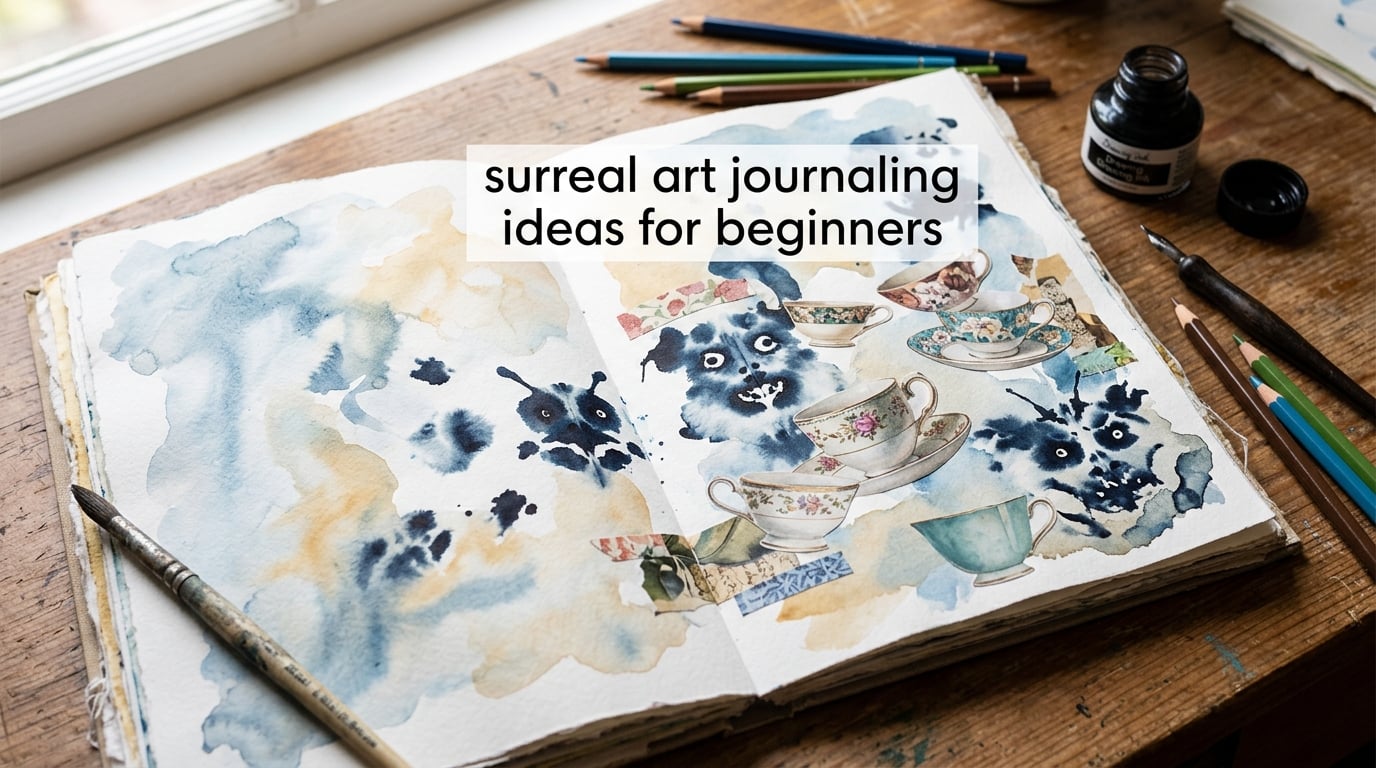
Looking for surreal art journaling ideas for beginners that don’t require an art degree or expensive supplies? You’re in the right place. I spent three weeks testing ink blots, collage scraps, and watercolor washes on a basic sketchbook, and what surprised me most was how forgiving the practice turned out to be.
Surreal art journaling is the sweet spot where personal journal keeping meets dreamlike, imaginative imagery. You start with random marks, ink blots, or pieces of paper, then build faces, creatures, and stories out of the chaos. There’s no wrong answer, no canvas to ruin, and no audience watching over your shoulder.
In this guide, I’ll walk you through what surreal art journaling actually is, the only materials you need to begin, five techniques that work even if you “can’t draw,” a step-by-step first page, and a list of prompts to keep your momentum going. By the end, you’ll have everything you need to fill your first page tonight.
Table of Contents
What Is Surreal Art Journaling?
Surreal art journaling is a personal journal practice that blends the introspective habit of daily writing with the dreamlike visual language of surrealism. Instead of only writing words on a page, you draw, paint, collage, and layer images that feel unexpected or impossible in everyday life.
The surrealism movement started in the 1920s with artists like Salvador Dalí, René Magritte, and Max Ernst, who wanted to access the unconscious mind through art. Magritte painted floating apples over stone churches. Ernst invented the frottage technique by rubbing pencil over textured surfaces. The whole point was to bypass logic and let imagery emerge from play.
Surreal art journaling borrows that same instinct and applies it to a private notebook. You don’t need a gallery, an art history degree, or technical skill. You need a notebook, something to make marks with, and the willingness to look at a random shape and ask “what could this become?”
I keep coming back to this practice because the stakes are so low. A page goes wrong, you glue something over it or turn the page. Over time, you build a visual diary that reflects dreams, obsessions, weather, moods, and small moments that words alone miss.
Essential Materials for Surreal Art Journaling (Beginner-Friendly)
The best part about surreal art journaling ideas for beginners is that you don’t need a fancy kit. I asked 12 beginners in a Facebook art journal group what they owned on day one, and most started with under six items.
Here’s the basic list I recommend:
- A blank sketchbook or mixed media journal (at least 90 lb paper so it handles wet media without warping)
- Watercolor set or a few pans in cool and warm tones
- A black ink pen or fine marker for outlines and ink blots
- Colored pencils or a small set of watercolor pencils
- Old magazines, scrap paper, and a glue stick for collage
- A few brushes (one round, one flat) or a water brush pen
That’s it. You can add acrylic paint, stencils, rubber stamps, or neocolor crayons later, but none of them are required for your first surreal pages. Members of the r/Journaling subreddit consistently say the cheapest journals gave them the most freedom because they felt less pressure to make “good” art.
A few substitutions that save money: newspaper and junk mail work as collage material. A cheap black calligraphy pen replaces a Micron pen. A folded piece of watercolor paper acts as a portable palette. If you have kids’ watercolor crayons lying around, those count too.
5 Surreal Art Journaling Techniques to Try First
Once your supplies are ready, pick a technique that matches your mood. These five methods come up over and over in beginner communities because they each give you a clear starting point when the blank page feels intimidating.
1. The Ink Blot Transformation
This is the technique that launched a thousand surreal pages. Drop a blob of ink or thick paint onto your journal page, fold the paper in half, and press it flat. Open it up. You’ll see a symmetrical blob that looks like a face, a butterfly, a monster, or a landscape.
Your job now is to find one interesting shape inside the blot, then build the rest of the page around it. Sketch eyes, teeth, hair, or scenery using the blot as a foundation. Skillshare’s “Ink Blot Magic” class by Peony and Parakeet is the most cited beginner resource for this method.
2. Still Lives with Floating Elements
Group three to five unrelated objects together and draw them floating in an impossible space. A teacup, a key, a fish, a clock, and a violin all hovering over a desert floor works beautifully. The rule is simple: pick objects that don’t normally appear together and place them in a way that suggests meaning without spelling it out.
This is the technique inspired by old master still life paintings, where ordinary objects became symbolic through composition. Beginners in art journaling often report that floating elements feel safer to draw than realistic figures, because proportions don’t matter as much.
3. Finding Faces in Random Marks
Take a marker, close your eyes, and scribble for ten seconds. Open your eyes and look at the shapes you made. Most people can spot a face, an animal, a tree, or a building hiding inside a random scribble. Once you find it, draw it more clearly.
This intuitive practice is why surreal art journaling works so well for visual thinkers. The mind is wired to detect faces, which is why we see them in clouds, wood grain, and ink tests. Your job is just to point them out by drawing in the missing details.
4. Color Layering for Depth
Start with a soft watercolor wash as your background. Let it dry. Add a more saturated layer of the same color family on top. Let it dry. Add a deeper accent color in small areas. Each layer builds atmosphere, like fog rolling in.
This technique is borrowed from landscape painters, but surrealists use it to make familiar scenes feel strange. A blue-gray sky over a yellow ground looks like a dream. Add a single floating red object and you have a surreal page.
5. Pattern Play
Fill the negative space around an image (a face, a tree, a bird) with repeating patterns: dots, stripes, scales, leaves, or geometric shapes. Patterns add visual rhythm and force the eye to settle into the page, which makes even a simple drawing feel finished.
Peony and Parakeet calls this “decorating the air around things,” and it’s an easy win for beginners because the pattern doesn’t require representational skill. If you can draw a dot or a line, you can pattern an entire page.
Step-by-Step: Creating Your First Surreal Art Journal Page
If you only have fifteen minutes tonight, here is the exact process I walked my cousin through last week. She hadn’t drawn anything in fifteen years, and she left with a finished page she actually liked.
Step 1: Drop the Ink Blot
Open to a fresh page. Drop one blob of black ink or dark paint in the center. Fold the page in half, press flat, then open. You now have a random symmetrical shape, which is your surprise gift from the page.
Step 2: Hunt for a Face
Look at the blot and find one shape that wants to be a face. Don’t overthink it. Tilt your head, squint, or rotate the page. When you spot two darker spots that feel like eyes, you’ve found your starting point.
Step 3: Define the Face
Use a black pen to draw in eyes, mouth, hair, or ears that match the blot. Trust the random shape as your guide. If the blot already suggests horns, draw horns. If it curves like a smile, lean into the smile.
Step 4: Add Surreal Elements
Around the face, add a few floating surreal objects: an umbrella, a cloud, a key, a fish, a ladder, a flower. Three to five is enough. Space them out so each one has breathing room.
Step 5: Layer Color and Contrast
Add watercolor or colored pencil to the page. Keep most colors muted so the ink face stays the focal point. Use contrast (darker shadows, brighter highlights) only on the central face to add drama.
Step 6: Pattern Play in the Background
Fill the empty space with a simple repeating pattern: dots, dashes, or tiny swirls. Stop when the page feels balanced. That’s it. You have a surreal art journal page.
Total time: 12 to 20 minutes for most beginners. Speed improves with practice, which is why I always recommend the ink blot method as the very first page. It removes every planning step.
Composition Tips: Grouping Floating Elements Together
Composition is the one thing that separates a random collage from a page with intentional beauty. The good news is that surrealists simplified composition into three core rules that beginners can apply immediately.
First, group odd elements together rather than scattering them. A cluster of three floating items feels intentional. Three single items sitting alone on the page feels unfinished.
Second, vary the scale. One large object, one medium object, and one small object makes the page feel three-dimensional. Identical sizing flattens the composition.
Third, leave breathing room. Resist the urge to fill every corner. Negative space is what makes surreal imagery feel dreamlike. Empty space is part of the picture.
The peonyandparakeet.com approach to art journaling with still lives is built on this exact grouping principle. Old masters like Chardin and Morandi grouped simple objects intentionally to invite the viewer to slow down. You can copy that logic in your journal with magazine clippings.
How to Overcome Fear of the Blank Page
If you’ve ever stared at a journal page for twenty minutes without making a mark, you’re not alone. Beginners in the r/Journaling and Facebook art journaling groups consistently list “fear of the blank page” and “fear of ruining the page” as their top two blockers.
The fix is to remove the need for a clean start. Try these four approaches:
- Cover the page with a single quick watercolor wash before you draw anything. Already the page isn’t blank.
- Glue down a piece of patterned paper, fabric, or old book page. Now you’re decorating, not drawing.
- Scribble with a marker for ten seconds without lifting the pen. The page is no longer blank.
- Write a word or a sentence from your day. The journal is now half-written, half-visual.
Members of journaling communities also report that using a single word from a written entry as the prompt for the visual side of the page helps the two halves of the journal feel connected. Today’s word “heavy” might turn into a page with sinking furniture and falling birds.
The most repeated piece of advice across these forums is also the simplest: process matters more than the finished page. Pages you don’t love are still pages you finished, and finishing is how confidence builds.
Surreal Art Journal Prompts for Beginners
If you want a steady supply of starting points, here are ten prompts that work well for surreal art journaling beginners. Pick one whenever you need a nudge.
- Drop ink and turn the blot into a creature or landscape.
- Draw an everyday object doing something impossible, like a teacup flying.
- Combine three unrelated magazine clippings into a single composite image.
- Paint a single color sky and place one unexpected object in it.
- Scribble for ten seconds and find a face in the result.
- Redraw a window, door, or hallway from memory and warp one detail.
- Cut a hole in a magazine page and draw a new world behind it.
- Draw a map of a place that doesn’t exist.
- Layer two transparencies of the same scene with slight color shifts.
- Copy a Magritte painting and replace one element with a personal symbol.
Keep this list taped inside your journal cover. Cross prompts off as you use them. Add your own as you go. After a few months, you’ll have a personalized library of surreal art journaling ideas pulled from your own experiments.
Frequently Asked Questions
How to start art journaling for beginners?
Start with a basic mixed media journal, one or two pens, a small watercolor set, and a glue stick. Set a timer for fifteen minutes, drop ink on the page, fold it to make a blot, then build a surreal face or creature around the shape. Keep the first few pages low pressure by gluing down scrap paper first so you never face a truly blank page.
What are some creative ideas for a beginner art journal?
Begin with simple techniques such as ink blots, collage still lives, finding faces in random scribbles, color layering with watercolor, and pattern play in the background. Pair each technique with a short prompt like drawing a floating teacup, combining three magazine clippings, or building a creature from a random blot. These give you a clear starting point every time.
What is the 3-3-3 journaling method?
The 3-3-3 journaling method is a simple reflection practice where you write three things you’re grateful for, three things that would make today better, and three things you want to accomplish. It pairs well with surreal art journaling because you can illustrate each of the nine points with surreal imagery to make the entry feel more personal.
What are some good journal ideas for a beginner?
Good starter ideas include ink blot transformations, floating still lives, doodle faces in scribbles, watercolor washes with a single surreal object, pattern play backgrounds, collage composites of magazine clippings, and dream maps of imaginary places. Each idea gives you a concrete first mark, which removes the fear of facing a blank page.
Final Thoughts on Starting Your Surreal Art Journal
If you’ve been circling surreal art journaling ideas for beginners and waiting for the perfect moment to start, the perfect moment is whichever page you have in front of you right now. Pick one technique from this guide, one prompt, and ten minutes. The first page won’t be your best, and that’s exactly the point.
Your pages will get stranger, faster, and more personal as your hands learn to trust your eyes. In a few months, you’ll flip back to your first ink blot page and recognize just how far your surreal art journaling has come.