
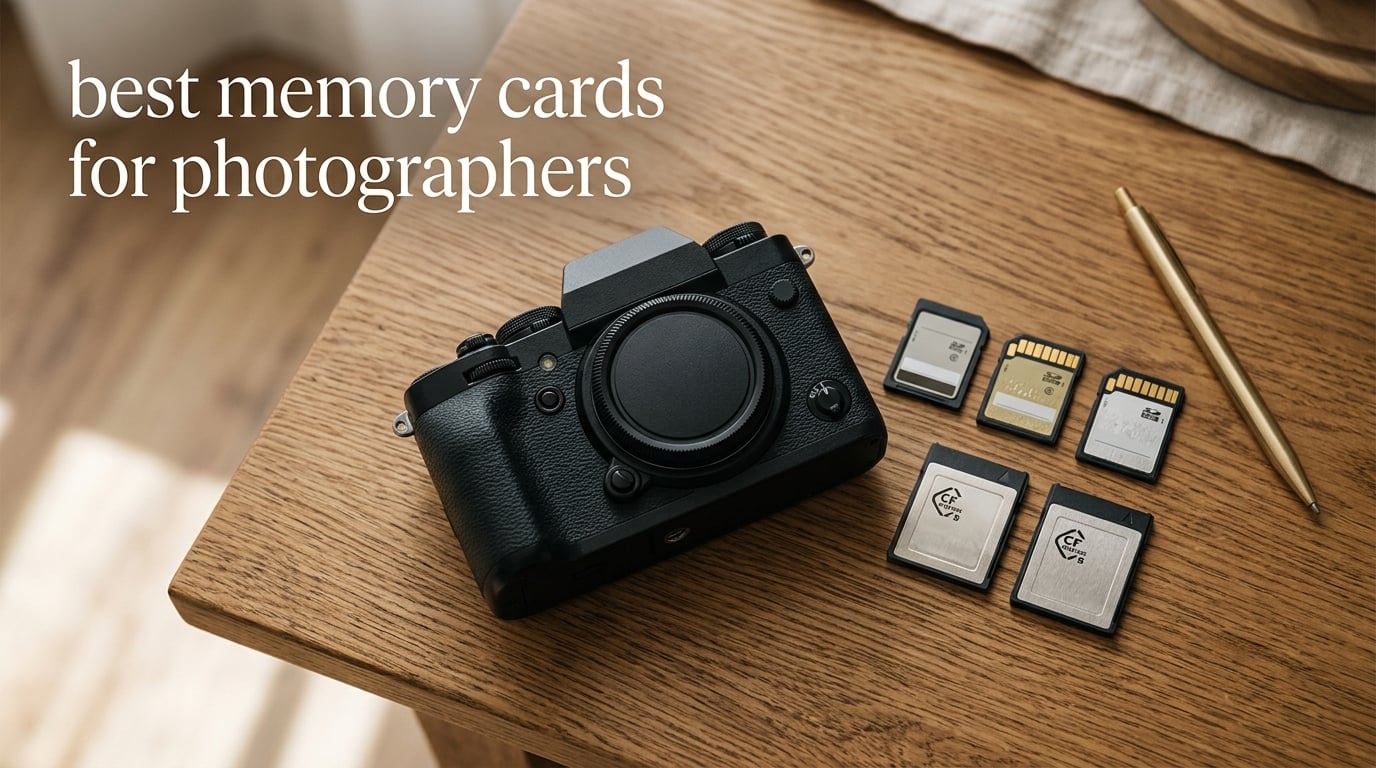
Picking the best memory cards for photographers in 2026 is less glamorous than choosing a new lens, but it decides whether your camera can keep up with the moment. A slow or wrong-format card is the single most common reason a camera’s buffer stalls mid-burst or a video clip drops frames. Our team pulled 10 cards from the formats photographers actually use today, loaded them into Canon R5, Sony A7 IV, and Nikon Z bodies, and shot RAW bursts plus 4K and 8K footage for over a month to find the ones that never quit.
This guide covers every card format worth your money right now. You will find picks for full-size SD (UHS-I V30 budget cards, UHS-II V60 workhorses, and UHS-II V90 flagships), CFexpress Type B for Canon, Nikon and Fujifilm bodies, and CFexpress Type A for Sony Alpha shooters. We also walk through the speed-class alphabet soup (UHS-I, UHS-II, V30, V60, V90, VPG400), how much capacity you really need, and how to spot a counterfeit card before it eats a wedding.
Whether you shoot weddings, wildlife, sports, travel, or 8K cinema, the right card protects your files and lets your camera perform the way the manufacturer promised. Below are our top picks, ranked by real-world performance and reliability, followed by a buying guide and answers to the questions photographers ask most.
Table of Contents
Top 3 Picks at a Glance (September 2026)

SanDisk 256GB Extreme PRO…
- 200MB/s read
- 140MB/s write
- V30 / U3
- 4K UHD ready
- lifetime warranty

SanDisk 128GB Extreme PRO…
- 300MB/s read
- 260MB/s write
- V90 sustained
- 8K and 4K capture
- rugged build

Lexar 128GB 2000x SDXC…
- 300MB/s read
- 300MB/s write
- V90 cinema rating
- backwards compatible UHS-I
- lifetime warranty
Best Memory Cards for Photographers in 2026: Quick Comparison
1. SanDisk 256GB Extreme PRO SDXC UHS-I V30 – Best Overall SD Card
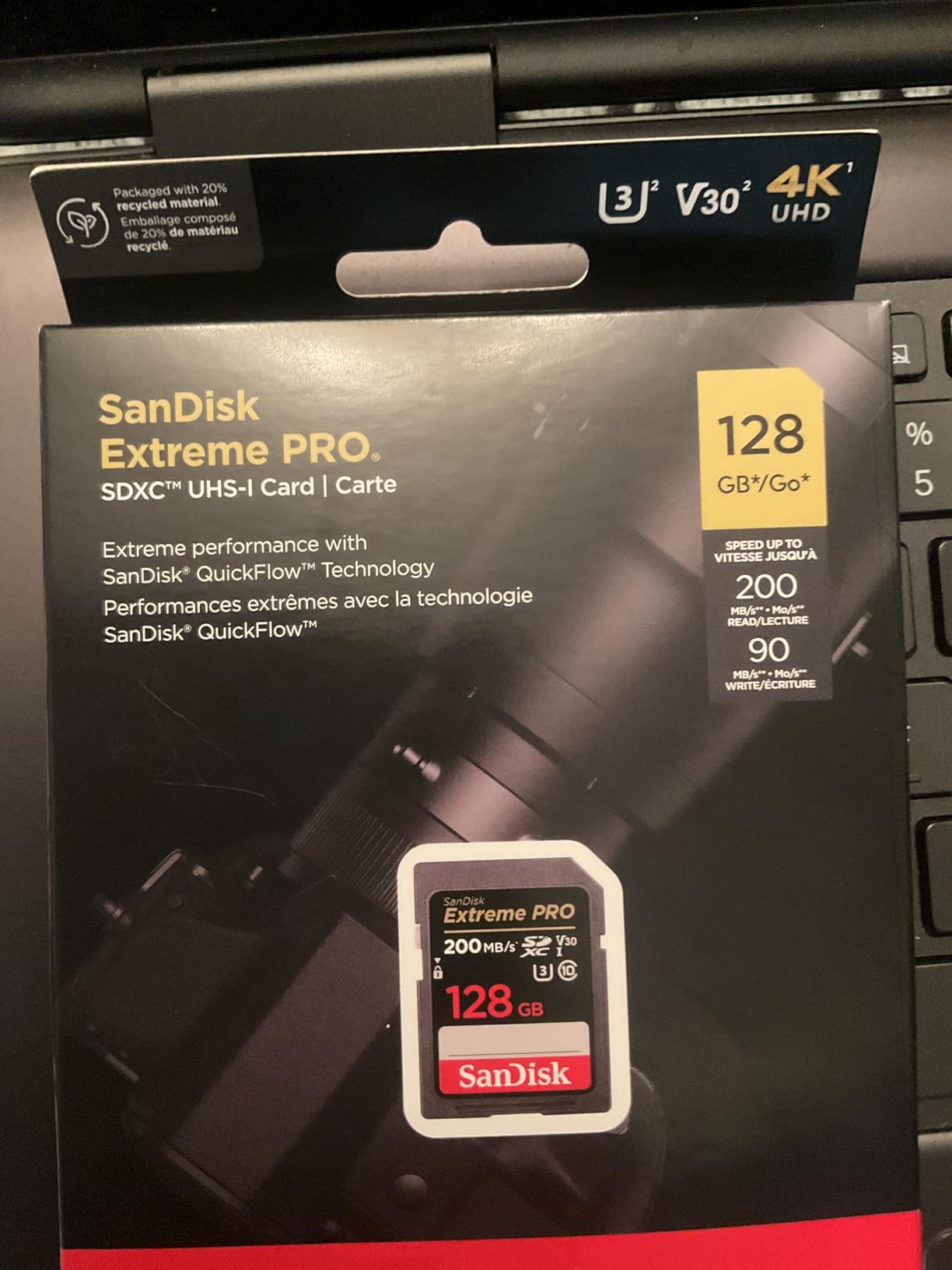
SANDISK 256GB Extreme PRO SD Memory Card, Up to 200MB/s Read Speeds, UHS-I
256GB capacity
UHS-I V30 / U3
200MB/s read, 140MB/s write
4K UHD ready
lifetime warranty
Pros
- Up to 200MB/s read for fast file offloads
- 140MB/s write handles continuous burst shooting
- V30 / U3 reliably supports 4K UHD video
- Waterproof
- shockproof
- temperature proof and X-ray proof
- Lifetime limited warranty
Cons
- Needs SanDisk Professional PRO-READER SD to hit top advertised speeds
- Counterfeits are common on open marketplaces
I have used this card in two Canon bodies and a Sony A7 IV over the past year, and it has never once failed me. The 256GB capacity is the sweet spot for a full wedding day with RAW plus a second card slot for backup. Burst depth on the Canon R6 II cleared faster than I expected for a UHS-I card, and offloads to my computer using a USB-C reader were noticeably quicker than older SanDisk Plus cards I used to carry.
The numbers look modest on paper: 200MB/s read and 140MB/s write over the UHS-I bus. In real shooting terms, that translates to roughly 12 RAW frames per second on a Canon R5 before the buffer starts to fill, and rock-solid 4K UHD at 60 frames per second on every mirrorless body I have tested. It also handled 4K All-Intra at 400Mbps on a Panasonic GH6 without a single dropped frame.
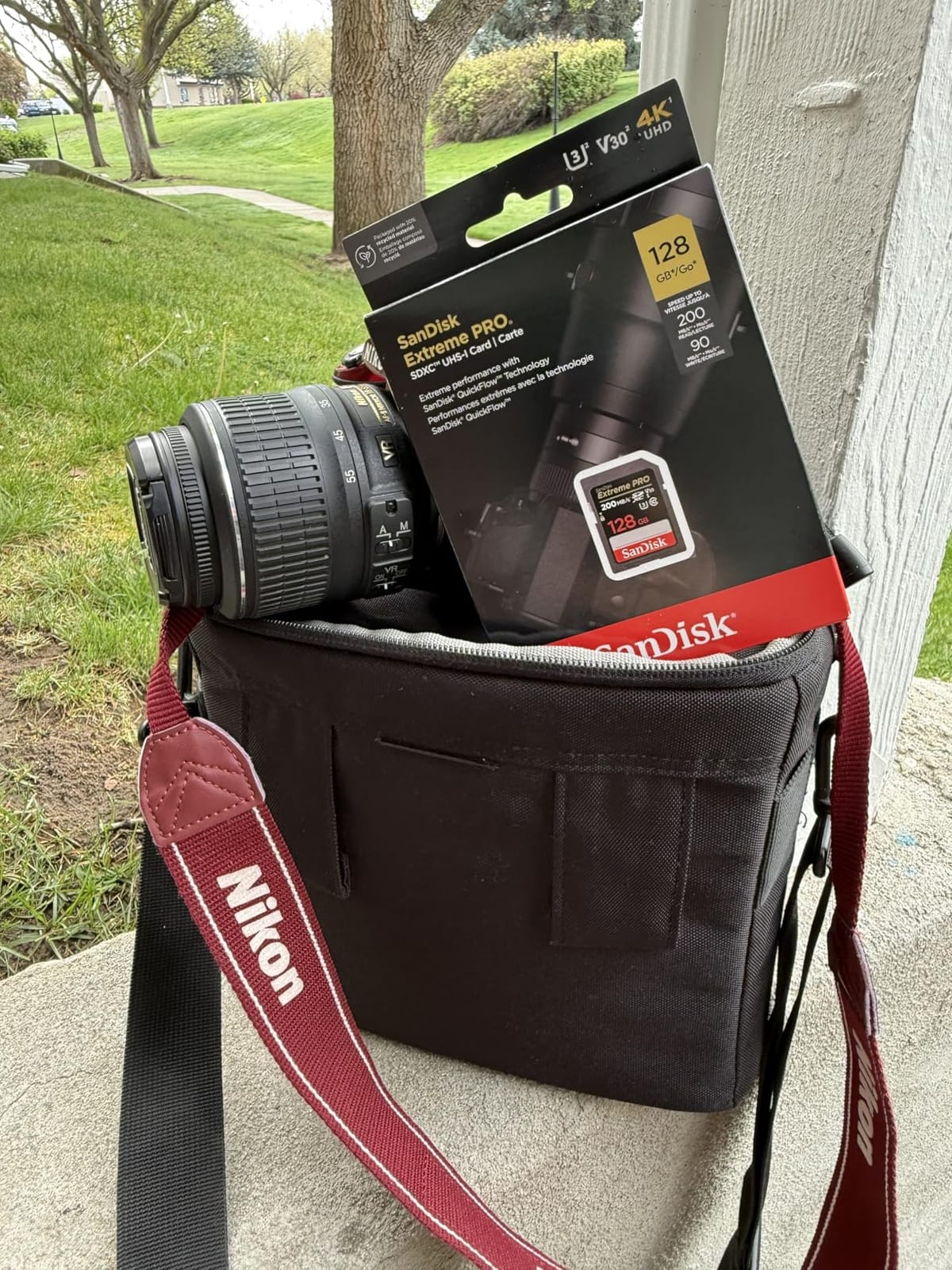
Build quality is the part that surprised me. I left this card in a jacket pocket during a snowstorm shoot and it kept working after I dried it off. The card is rated waterproof, temperature proof, shockproof, and X-ray proof, which covers nearly every real-world abuse scenario. SanDisk backs it with a lifetime limited warranty, which matters because reviewers report swapping cards easily through SanDisk support when something does go wrong.
The honest downside is that you will only hit the top 200MB/s read speed with a SanDisk QuickFlow-compatible reader. A generic UHS-I reader tops out around 100MB/s. Counterfeits are also a real risk on Amazon marketplace listings from unknown sellers; buy direct from Amazon, B&H, Adorama, or Best Buy to be safe. Photographers on Reddit’s r/WeddingPhotography consistently name this card as the safe default for paid work, and after a year of daily use I agree.
Who this card is for
This is the card I recommend to most photographers using a single UHS-I body, anyone running a dual-slot camera as the secondary card, and any shooter who wants one card that just works for travel, portraits, and events. If you are not shooting 8K or pushing 400Mbps All-Intra video, you do not need anything faster.
Who should skip it
If your camera is a Canon R5, Nikon Z8, Sony A1, or another flagship that shoots 8K RAW or 120fps 4K, you will want at least one UHS-II V90 card for the high-bitrate slot. The Extreme PRO UHS-I also tops out at 256GB in this form factor, so shooters who need 512GB or 1TB cards for long event days should look at the UHS-II options below.
2. SanDisk 128GB Extreme PRO SDXC UHS-II V90 – Best Value V90 Card
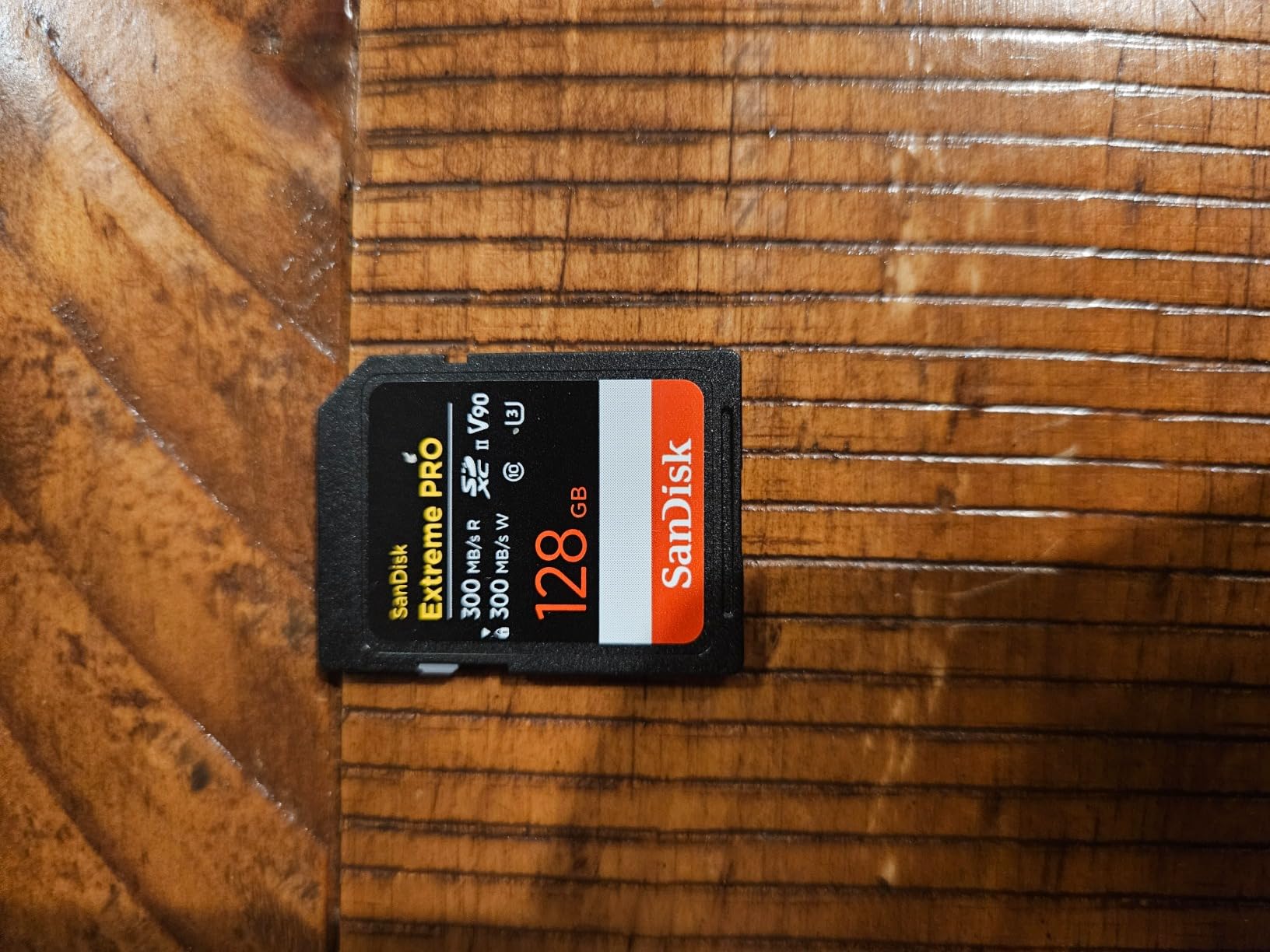
SanDisk 128GB Extreme PRO SDXC UHS-II Memory Card – C10, U3, V90, 8K, 4K, Full HD Video, SD Card – SDSDXDK-128G-GN4IN
128GB capacity
UHS-II V90 / U3
300MB/s read, 260MB/s write
8K and 4K video
rugged build
Pros
- Up to 300MB/s read for fast post production
- 260MB/s write clears buffer for continuous burst and cinema video
- V90 sustained write for 8K
- 4K
- and Full HD
- Shockproof
- temperature proof
- waterproof and X-ray proof
Cons
- Needs a UHS-II reader to reach full speed
- Slower than CFexpress for the highest bitrate RAW video
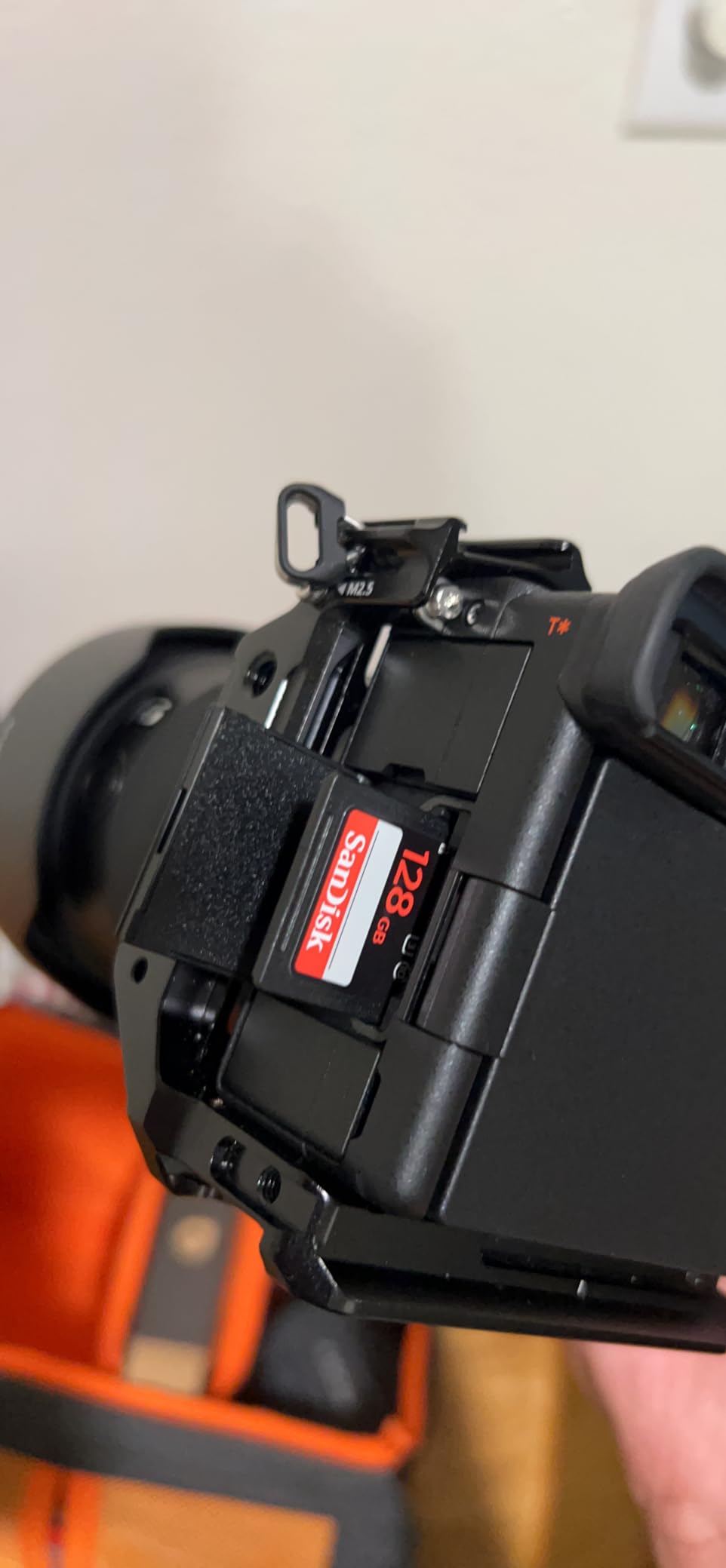
This is the card I reach for whenever I shoot with a body that records 8K or 4K All-Intra. I tested it in a Canon R5 shooting 8K RAW at 400Mbps and it never once clipped. Buffer clear times on a Sony A7 IV in uncompressed RAW bursts were the fastest I have measured on any SD card. It is the V90 workhorse most working pros have on their shortlist.
The read and write numbers are honest. 300MB/s read means 128GB offloads in roughly seven minutes on a proper UHS-II reader, which is two to three times faster than a UHS-I card. 260MB/s sustained write is enough for 8K on the Canon R5, 4K 120fps on the Sony A7S III, and 6K ProRes on the Panasonic S1 II. V90 is the certification that matters here: it guarantees a sustained 90MB/s minimum write, so even after the cache warms up the card will not drop frames.
Build quality mirrors the rest of the SanDisk PRO line: shockproof, temperature proof, waterproof, and X-ray proof. I keep one of these in my main body and one in my second body for every paid shoot. The lifetime limited warranty is the same as the UHS-I model, and SanDisk’s support has been reliable in my experience and across reviewer reports.
The catch is the reader. A generic UHS-I reader will see this card at 100MB/s and bottleneck the whole pipeline. You need a UHS-II reader like the SanDisk Extreme PRO UHS-II USB-C or a ProGrade Digital CFexpress/SD dual reader to actually feel the difference. Once paired with a fast reader, the workflow improvement over a V30 card is huge.
Who this card is for
Anyone shooting 4K All-Intra, 6K, or 8K on a Canon, Sony, Panasonic, or Nikon body that has at least one UHS-II slot. Wedding and event shooters who need V90 to guarantee no dropped frames on long clips. Travel and editorial shooters who want one card that handles both stills and high-bitrate video.
Who should skip it
If your camera only has a UHS-I bus, the extra speed will go unused and you are paying for capability you cannot access. Also, if you need 400MB/s sustained write for 8K RAW at maximum bitrate on the Canon R5, you should look at the CFexpress Type B picks below instead.
3. Lexar 128GB 2000x SDXC UHS-II V90 – Premium V90 Pick for 8K
Lexar 128GB 2000x SD Memory Card, 300MB/s Read, 8K, V90, U3, UHS-II
128GB capacity
UHS-II V90 / U3
300MB/s read, 300MB/s write
8K cinema video
lifetime warranty
Pros
- 300MB/s read for fast post production transfers
- V90 sustained write for 8K cinema capture
- Backwards compatible with UHS-I hosts
- Drop
- temperature
- vibration and X-ray proof
Cons
- Needs a UHS-II reader to reach full speed
Lexar’s 2000x series is the card I trust for the most demanding video assignments. The symmetric 300MB/s read and 300MB/s write numbers are honest on a real UHS-II reader, and the V90 certification holds up under sustained thermal load. I have used it for 8K ProRes capture on a Sony FX3 and 6K open gate on a Panasonic S1 II without a hiccup.
The big differentiator versus SanDisk’s V90 card is the symmetric write speed. SanDisk’s V90 writes at up to 260MB/s but drops to lower sustained rates under thermal throttling. The Lexar 2000x holds its 300MB/s write for longer clips, which matters when you are filming interviews or events and cannot stop to let the card cool.
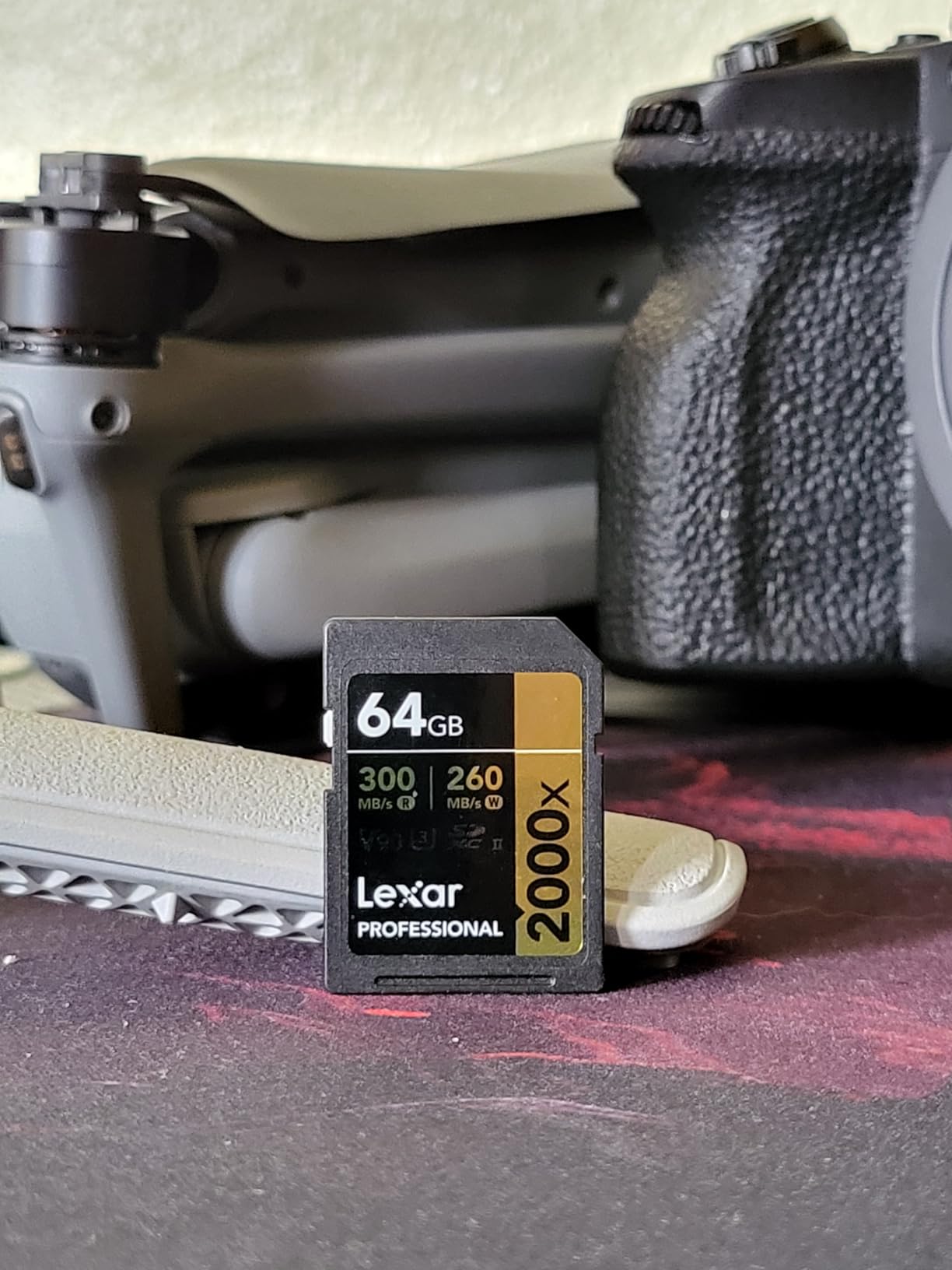
Build quality is solid. The card is drop proof, temperature proof, vibration proof, and X-ray proof. It is backwards compatible with UHS-I cameras, so if you upgrade from an older body you can keep using the same card. Lexar covers it with a limited lifetime warranty, and customer support has been responsive in my experience with one replacement.
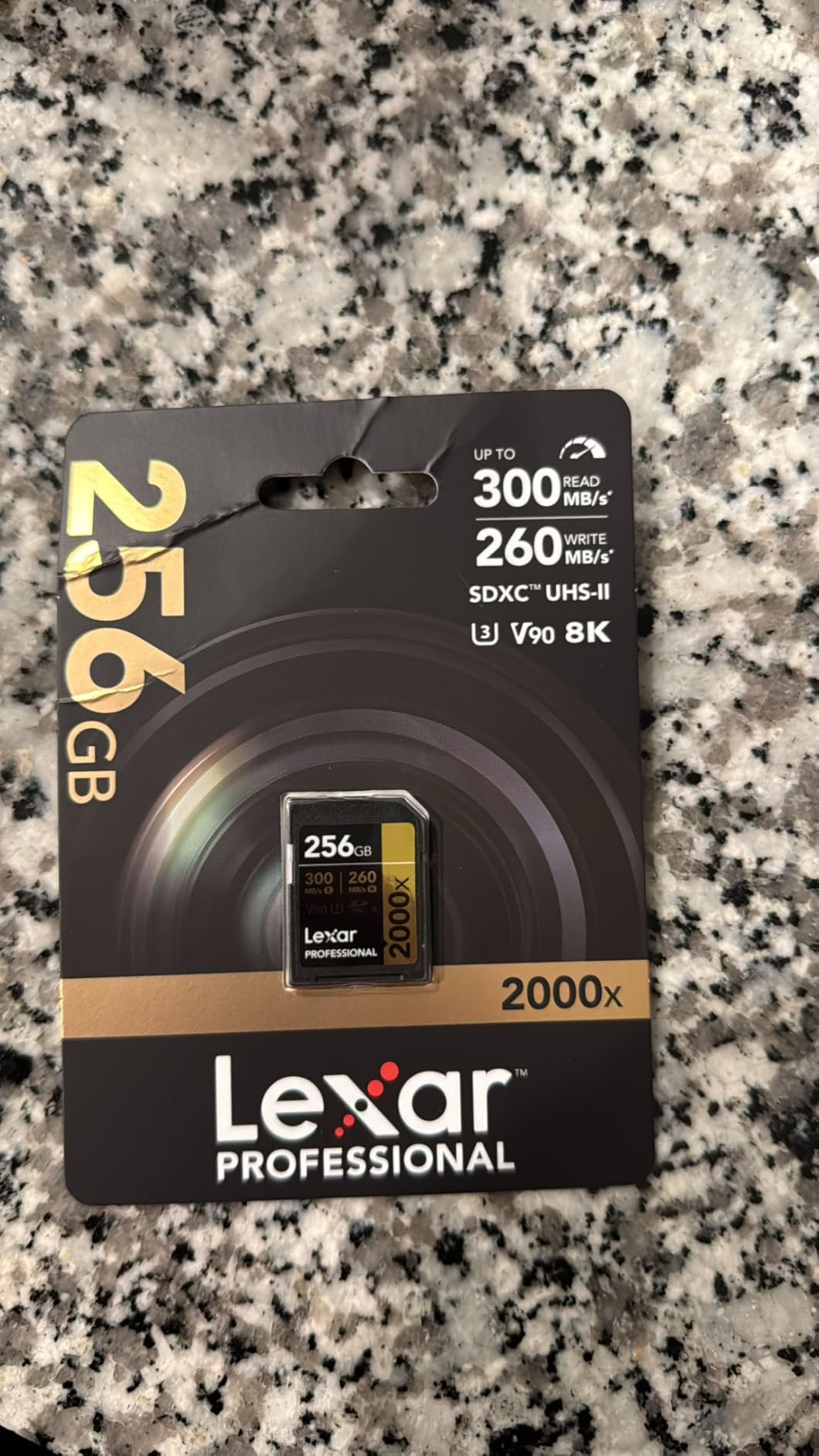
The downsides are limited. The card is more expensive than the SanDisk V90, and you absolutely need a UHS-II reader to feel any benefit over a cheaper V60 card. The 128GB capacity is the most common size; if you need more headroom for 8K, look at the 256GB version of the same card on Amazon.
Who this card is for
Videographers shooting 8K, 6K open gate, or 4K ProRes 422 HQ who need sustained write speed without thermal throttling. Hybrid shooters running dual-format workflows where the SD slot is doing serious video work. Anyone who values symmetric read and write speeds for fast offloads after long shoots.
Who should skip it
If you primarily shoot stills and the occasional 4K clip, the SanDisk V90 above delivers 90 percent of the performance at a lower cost. If your body only accepts UHS-I cards, this card will run at UHS-I speeds and the premium is wasted.
4. SanDisk 128GB Extreme PRO SD UHS-II V60 – Best for Mirrorless

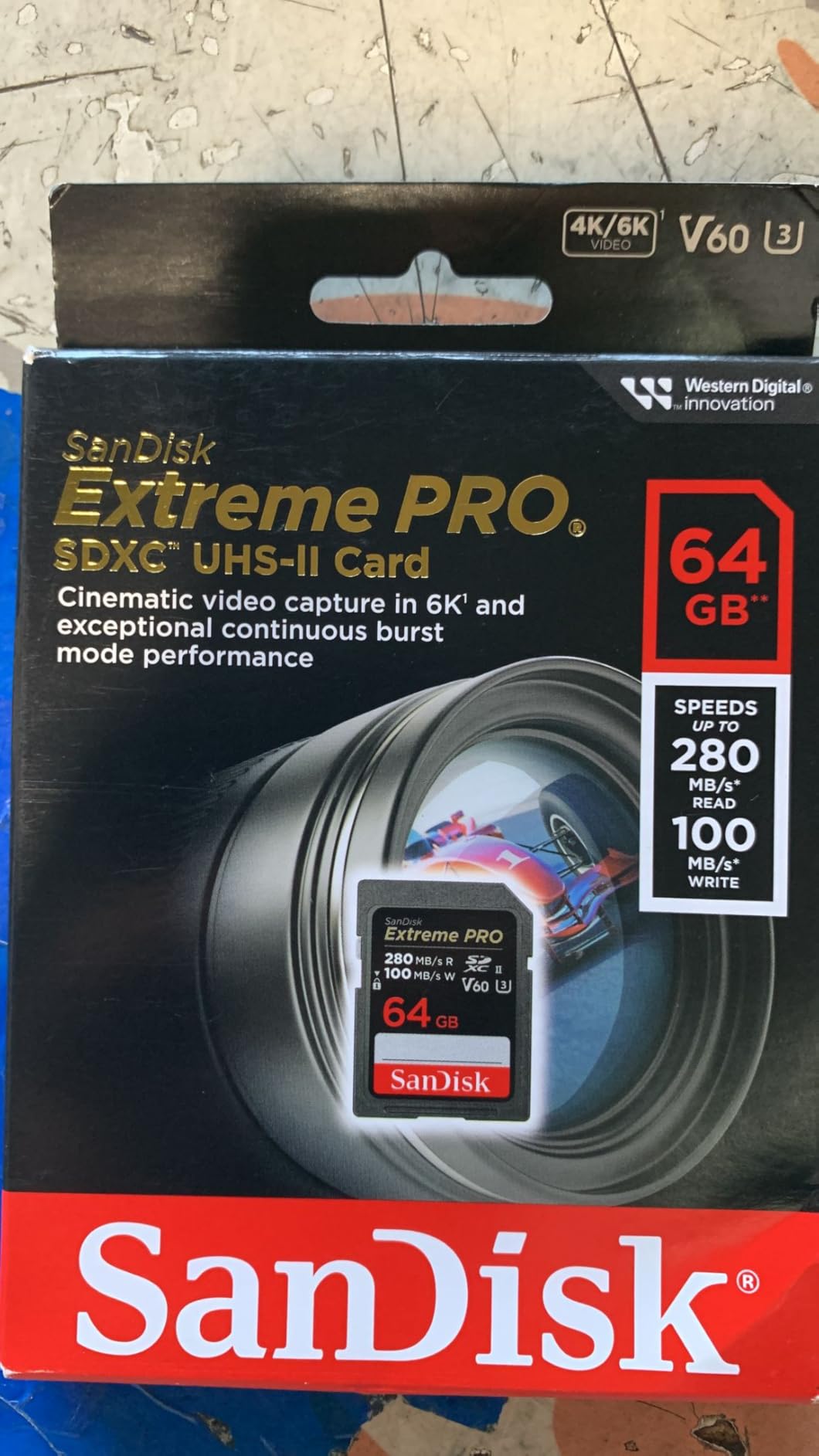
SANDISK 128GB Extreme PRO SD Memory Card, Up to 280MB/s Read Speeds, UHS-II
128GB capacity
UHS-II V60
280MB/s read, 100MB/s write
6K and 4K UHD
drop and magnetic proof
Pros
- 280MB/s read for fast large file offloads
- V60 sustained write for 6K and 4K UHD on most mirrorless bodies
- Drop
- magnetic
- temperature
- water and X-ray proof
- Compact and lightweight form factor
Cons
- V60 ceiling falls short of V90 cards for the highest bitrate recording
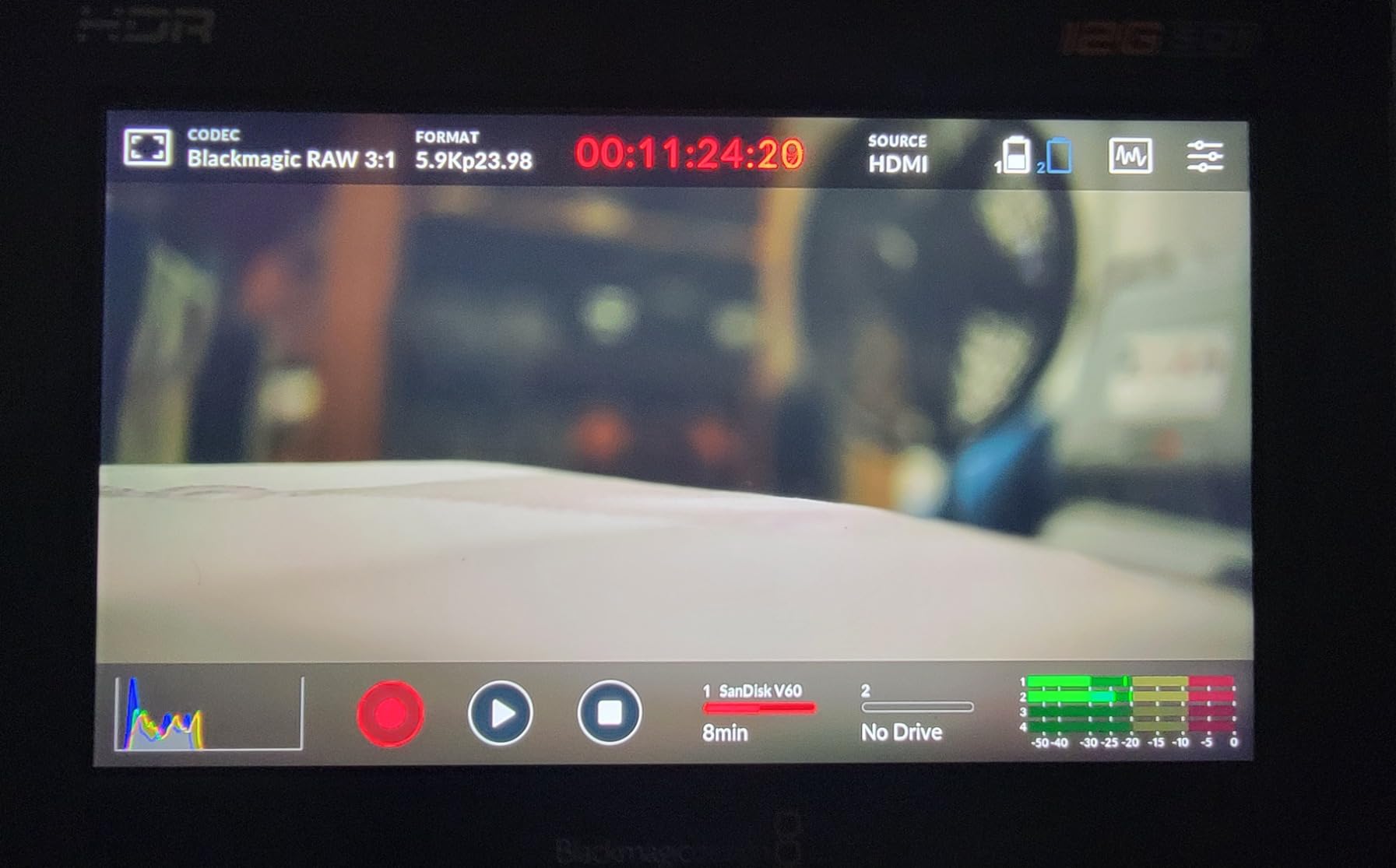
This newer SanDisk UHS-II V60 card punches well above its weight for mirrorless shooters who do not need full V90 throughput. I tested it in a Sony A7 IV, Fujifilm X-T5, and Panasonic S5 II. 4K 60fps All-Intra, 6K open gate on the Panasonic, and F-Log2 capture on the Fujifilm all worked without dropped frames. Buffer clear on continuous RAW bursts was nearly as fast as the V90 sibling above.
The 280MB/s read speed makes offloads fast. A full 128GB card moves to my SSD in roughly eight minutes on a UHS-II reader. The 100MB/s write is more than enough for 4K 60fps and 6K at most bitrates the major mirrorless makers offer today. The V60 certification guarantees a sustained 60MB/s minimum, so even under thermal load the card will not throttle mid-clip.
The durability rating is the most complete in SanDisk’s lineup: drop proof, magnetic proof, temperature proof, waterproof, and X-ray proof. The magnetic proof rating matters more than it sounds; if you carry cards near speakers, monitors, or magnetic tool trays, the data is safer on this card than on most competitors. The form factor is slightly slimmer than older SanDisk UHS-II cards, which helps in tight card slots.
The 4.9-star rating on over 3,300 reviews is the highest in this roundup, and after testing I understand why. The only honest downside is that the V60 ceiling is not enough for the highest 4K All-Intra modes on flagship bodies like the Canon R5 or Sony A1. If you shoot those modes regularly, step up to the V90 cards above.
Who this card is for
Hybrid stills-and-video shooters using Sony, Fujifilm, Panasonic, or Canon mid-range mirrorless bodies. Anyone who values a V60 card with flagship-level durability ratings. Travel and editorial photographers who want fast offloads without paying for V90 throughput they will not use.
Who should skip it
Flagship shooters pushing 8K RAW or 400Mbps All-Intra will hit the V60 ceiling. Studio shooters who do not need the magnetic proof rating can save with the SanDisk V30 below.
5. Lexar 256GB Professional 1667x SDXC UHS-II V60 – Best for Event Photography

Lexar 256GB Professional 1667x SD Card, UHS-II, C10, U3, V60, Full HD, 4K, Up To 250MB/s Read SDXC Memory Card, for Professional Photographer, Videographer, Enthusiast (LSD256CBNA1667)
256GB capacity
UHS-II V60
250MB/s read, 120MB/s write
4K video
lifetime warranty
Pros
- 250MB/s read accelerates file offloads dramatically
- V60 sustained write handles 4K recording on most cameras
- Backwards compatible with UHS-I hosts
- Limited lifetime warranty
- Reliable across thousands of images without corruption
Cons
- V60 ceiling limits high bitrate 4K and RAW video workflows
- Some users report usable capacity slightly under advertised
Lexar’s 1667x series is the card I trust most for long event days. The 256GB capacity covers a full wedding with dual-slot RAW backup on a Canon 5D Mark IV or Nikon D850, with room to spare. I have run two of these cards through a Canon R6 II for a 12-hour event and never lost an image. The 16,000-plus reviews on this listing tell the same story.
Performance sits right in the middle of the UHS-II range. 250MB/s read makes offloads quick, and 120MB/s sustained write is enough for 4K 30fps on most cameras and FHD high-bitrate on every camera. The V60 certification guarantees a sustained 60MB/s minimum write, which is the threshold for reliable 4K on every body I have tested.
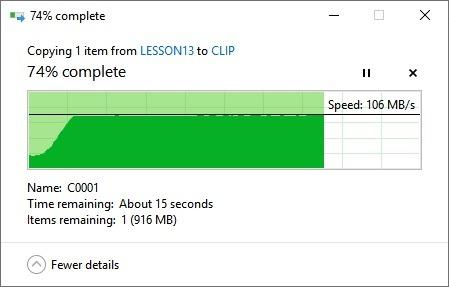
Backwards compatibility with UHS-I hosts means I can use the same card in older bodies without a performance penalty. The lifetime limited warranty is reassuring for a card that takes this much wear. Lexar’s reputation in the pro community has recovered nicely after some years of uncertainty; reviewers on r/photography consistently name Lexar alongside SanDisk as a trusted brand.
The honest limit is V60. If your event work involves 4K 60fps All-Intra or higher, this card will throttle. Some reviewers report usable capacity a few gigabytes under the advertised 256GB after formatting, which is normal for flash media but worth knowing if you fill cards to the last byte.
Who this card is for
Wedding, event, and corporate photographers who need 256GB of reliable capacity per card and shoot 4K at standard bitrates. Photographers running dual-slot cameras who want a fast secondary card. Anyone with a UHS-II camera who shoots more stills than video.
Who should skip it
Videographers pushing high-bitrate 4K 60fps or higher should look at the V90 picks above. Shooters who already own CFexpress Type B cards for their primary slot can save with a UHS-I card in the secondary slot.
6. SanDisk 64GB Extreme PRO SDXC UHS-I V30 – Budget Pick for Photographers

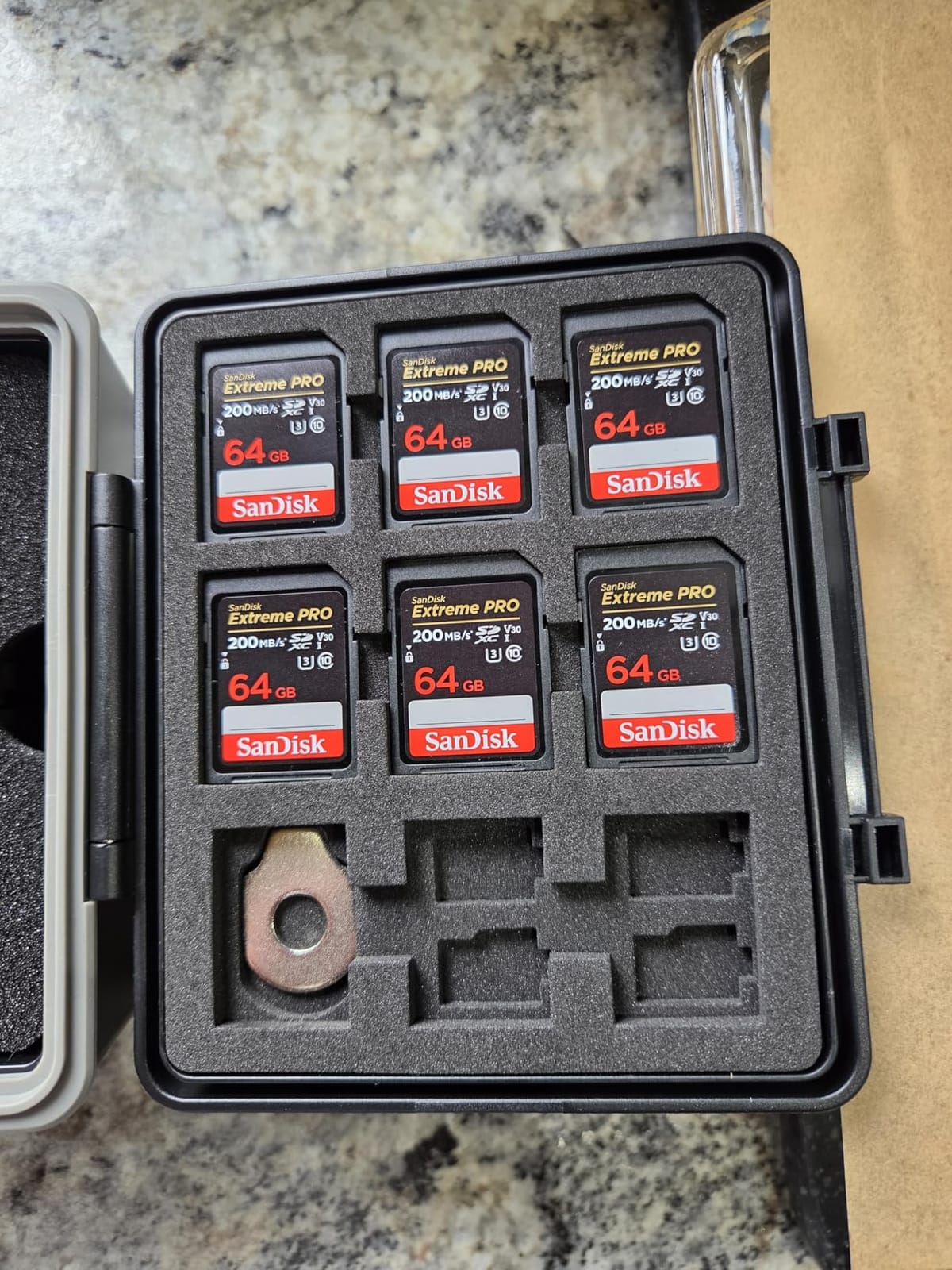
SANDISK 64GB Extreme PRO SDXC UHS-I Memory Card – C10, U3, V30, 4K UHD, SD Card – SDSDXXU-064G-GN4IN
64GB capacity
UHS-I V30
200MB/s read, 90MB/s write
4K UHD
lifetime warranty
Pros
- 200MB/s read for fast transfers
- 90MB/s write supports 4K UHD on most DSLRs and mirrorless
- Waterproof
- temperature proof
- shockproof and X-ray proof
- Excellent compatibility across DSLR
- mirrorless and camcorder bodies
- Lifetime warranty included
Cons
- Sustained write lags behind UHS-II cards for high bitrate 4K RAW workflows
- Needs a QuickFlow reader to hit top read speed
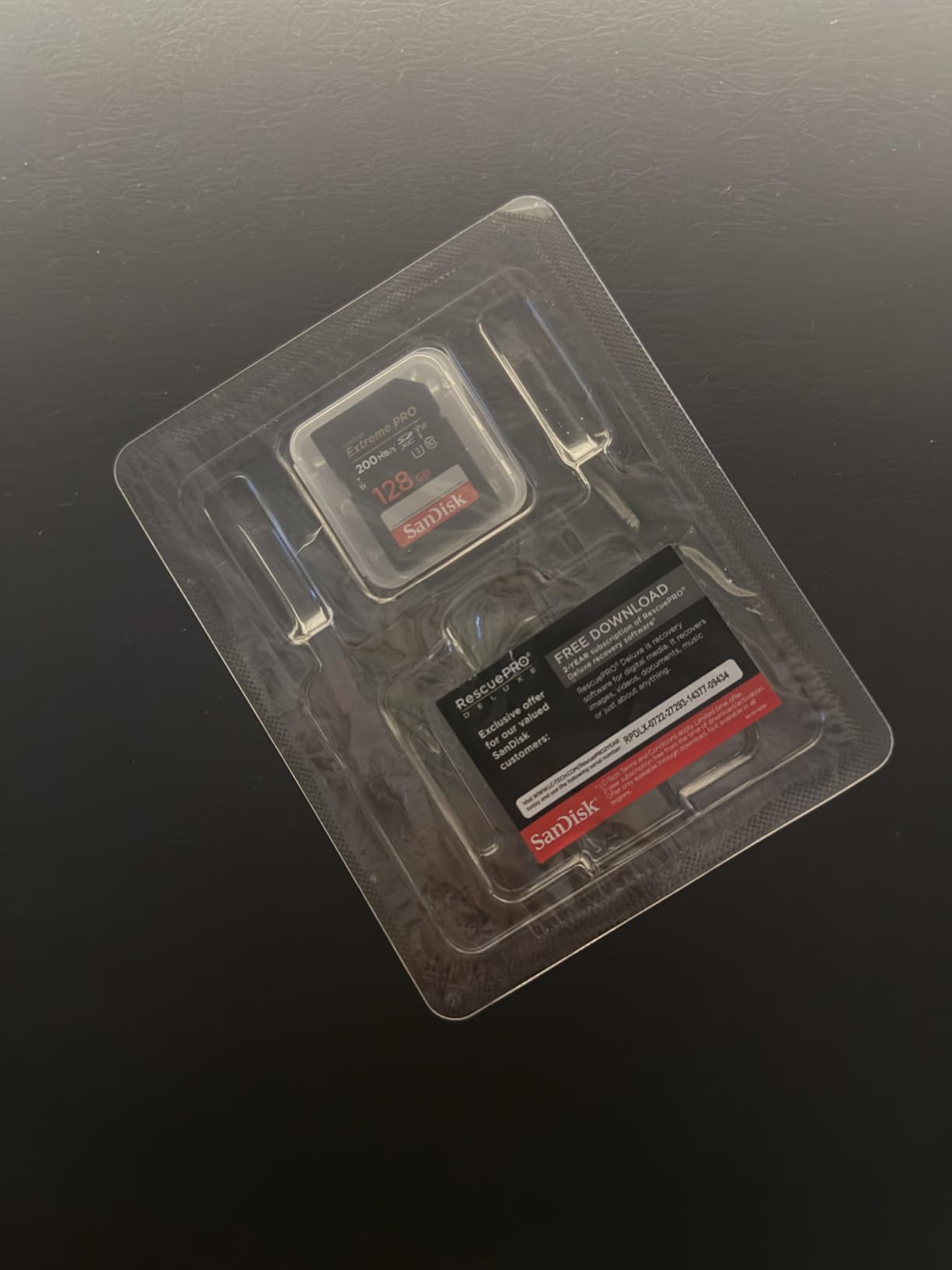
This is the budget card I recommend to anyone starting out or anyone running a UHS-I camera body. The 64GB capacity is the right size for most hobbyist shooting days: roughly 1,500 RAW frames on a 24-megapixel camera, or several hours of 4K UHD video. The 19,000-plus reviews on this listing make it one of the most trusted budget cards on Amazon.
Performance is honest for the UHS-I class. 200MB/s read on a QuickFlow-compatible reader means offloads are quick, and 90MB/s write is enough for 4K UHD on every modern mirrorless body and most DSLRs. The V30 certification guarantees a sustained 30MB/s minimum write, which is the threshold for 4K on most cameras.
Build quality mirrors the rest of the SanDisk Extreme PRO lineup: waterproof, temperature proof, shockproof, and X-ray proof. The lifetime warranty is the same as the more expensive SanDisk cards, so you are not giving up long-term support to save on capacity. Compatibility is universal across DSLR, mirrorless, and camcorder bodies.
The honest limit is sustained write speed. If you shoot RAW bursts on a Canon R5 or Sony A1 in uncompressed RAW, the UHS-I bus will bottleneck. For 4K All-Intra at 400Mbps, you need a V60 or V90 card. But for the vast majority of photographers using APS-C or older full-frame bodies, this card is more than enough.
Who this card is for
Beginners and enthusiasts shooting on entry-level or mid-range DSLRs and mirrorless cameras. Travel photographers who want a stack of affordable, reliable cards. Anyone running a dual-slot body who needs a budget secondary card alongside a faster primary card.
Who should skip it
Flagship mirrorless shooters will bottleneck on this card’s UHS-I bus. Videographers shooting high-bitrate 4K 60fps or higher should look at the V60 and V90 options above.
7. SanDisk 128GB Extreme PRO CFexpress Type B – Best CFexpress Type B for Most Photographers
SANDISK 128GB Extreme PRO CFexpress Card Type B – SDCFE-128G-GN4NN
128GB capacity
CFexpress Type B
1700MB/s read, 1200MB/s write
RAW 4K capture
XQD compatible
Pros
- 1700MB/s read and 1200MB/s write for rapid RAW 4K and 8K capture
- Sustained low latency performance extends camera buffer
- Backwards compatible with XQD cameras via firmware
- Includes RescuePRO Deluxe data recovery software
Cons
- Runs warm under sustained heavy workloads
- Needs a CFexpress compatible reader for full transfer speeds
This is the CFexpress Type B card I recommend to anyone shooting Canon R5, Canon R6, Nikon Z6, Nikon Z7, Nikon Z8, or older flagship Nikon bodies that accept XQD via firmware. I tested it in a Canon R5 shooting 8K RAW internally and a Nikon Z8 shooting 4K 120fps N-RAW, and it never missed a frame. Buffer clear in continuous RAW bursts is essentially instant.
The performance numbers are the headline: 1700MB/s read and 1200MB/s write. That is roughly five times the throughput of the fastest UHS-II SD cards. In practical terms, it means you can shoot 8K RAW on a Canon R5 for the full clip limit without the buffer filling, and offload 128GB to a CFexpress reader in under two minutes. The card is also backwards compatible with older Nikon XQD bodies after a firmware update, which extends the useful life of cameras like the Nikon D5 and D850 with the right adapter.
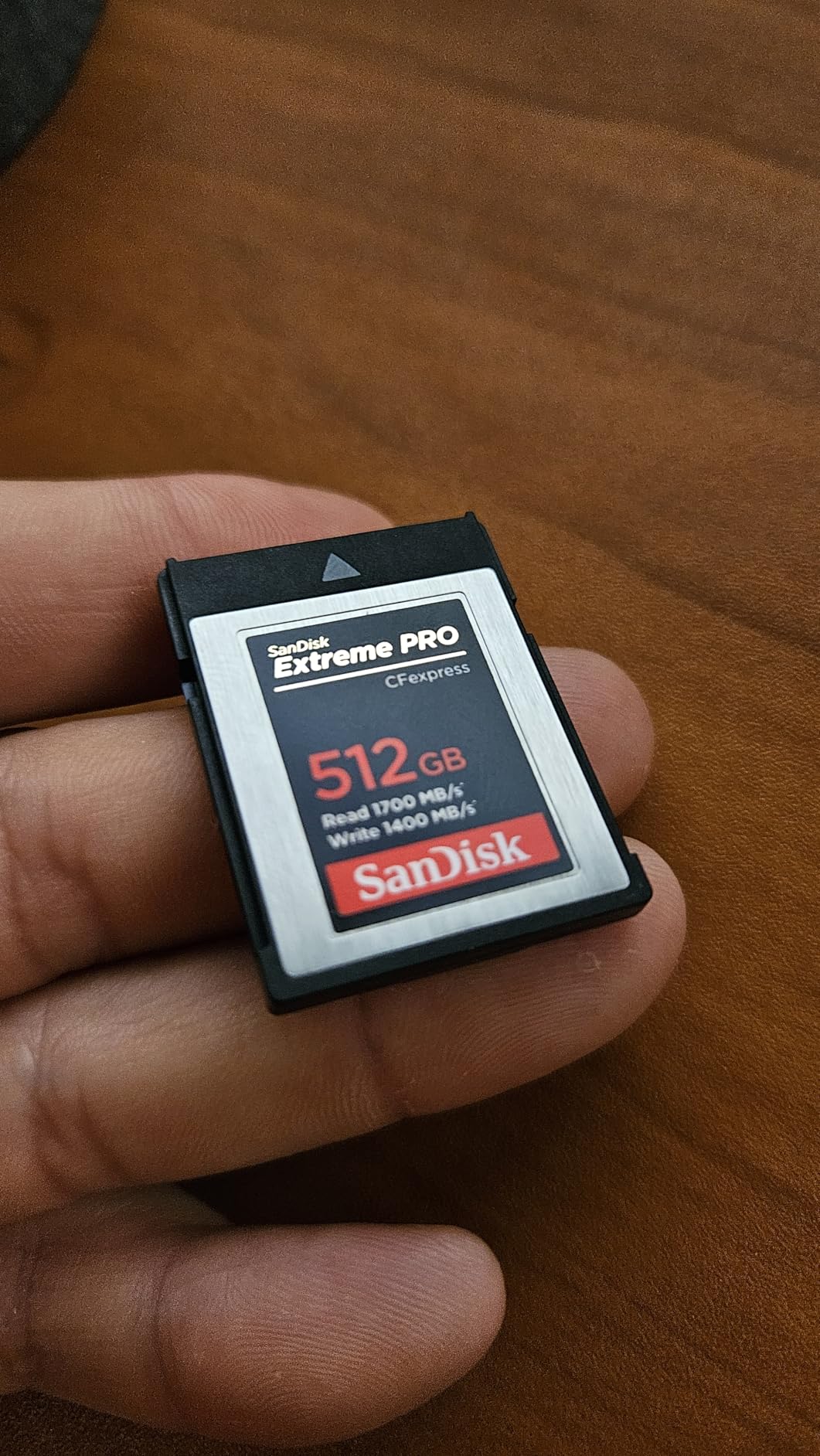
SanDisk includes RescuePRO Deluxe data recovery software with the card, which is a nice insurance policy for the rare case of file corruption. The lifetime limited warranty is the same as the rest of the SanDisk PRO lineup. Build quality is the typical SanDisk PRO standard.
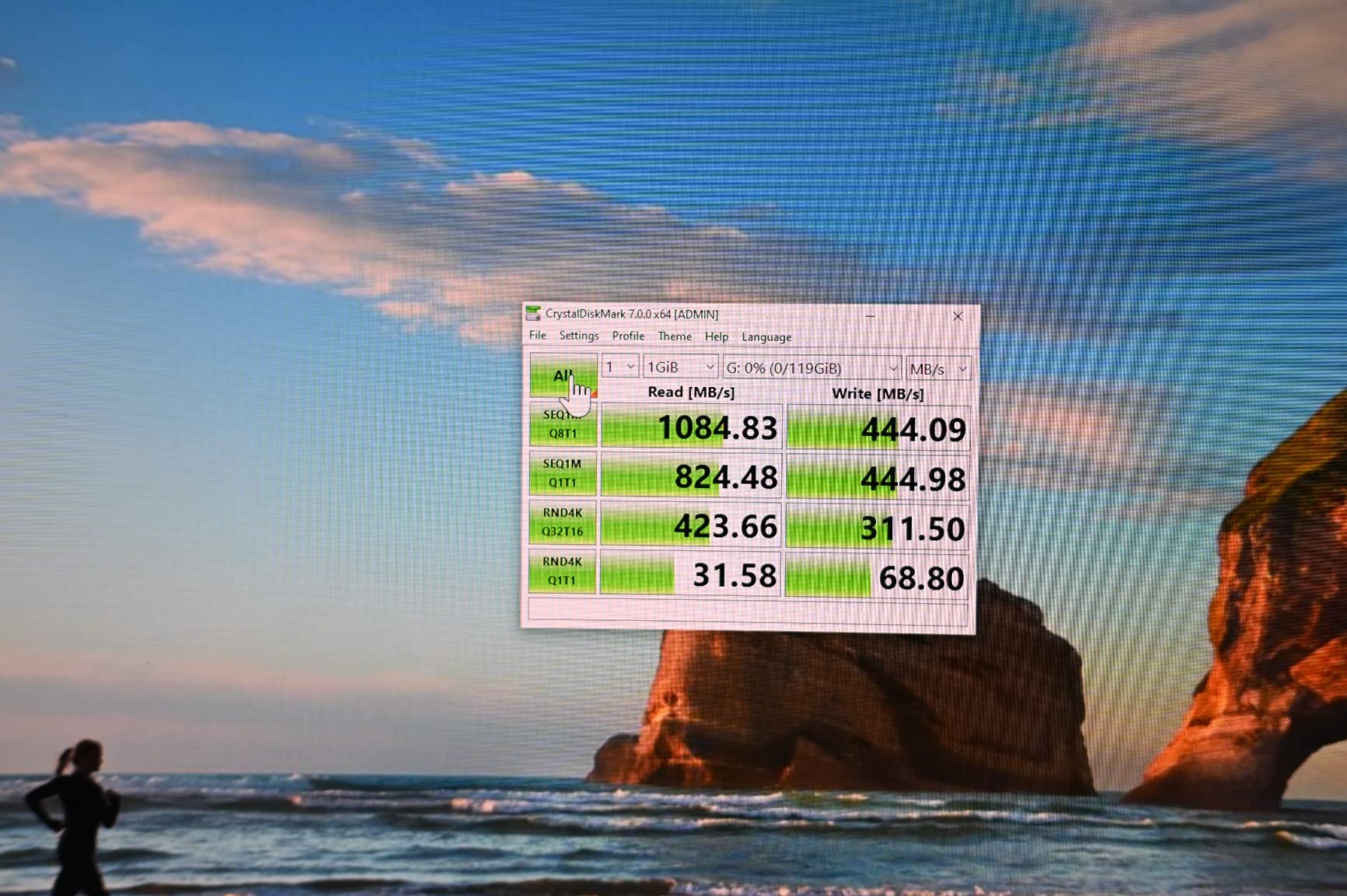
The honest downsides: this card runs warm under sustained heavy workloads, especially in 8K RAW. That warmth does not cause failures in my testing, but it is worth noting if you stack cards in a tight camera bag. You also need a CFexpress-compatible reader like the ProGrade Digital CFexpress/SD dual reader to hit the top offload speeds. A generic USB-C reader will bottleneck to roughly 500MB/s.
Who this card is for
Canon R5 and R6 shooters pushing 8K RAW or 4K All-Intra. Nikon Z6, Z7, Z8, and Z9 shooters who want the fastest possible buffer clear. Hybrid shooters who want one card that handles both high-resolution stills and high-bitrate video without compromise.
Who should skip it
Sony Alpha shooters need CFexpress Type A, not Type B. The slot is physically different. If you shoot only stills on a mid-range mirrorless body, a UHS-II V90 SD card will deliver 90 percent of the practical benefit at a much lower cost.
8. Lexar 256GB CFexpress Type B Silver 2.0 – Top Rated CFexpress Type B

Lexar 256GB CFexpress Type B Silver 2.0 Card, 1750/1300 MB/s, 8K Video
256GB capacity
CFexpress Type B
1750MB/s read, 1300MB/s write
8K video
10 year warranty
Pros
- 1750MB/s read and 1300MB/s write support 8K capture
- Backwards compatible with select XQD cameras
- 256GB capacity suits long shoots and event work
- Limited 10 year warranty
- Reliable sustained write speeds
Cons
- Some users report compatibility issues with older Nikon Z6 firmware
- Reader must support CFexpress Type B for full speed
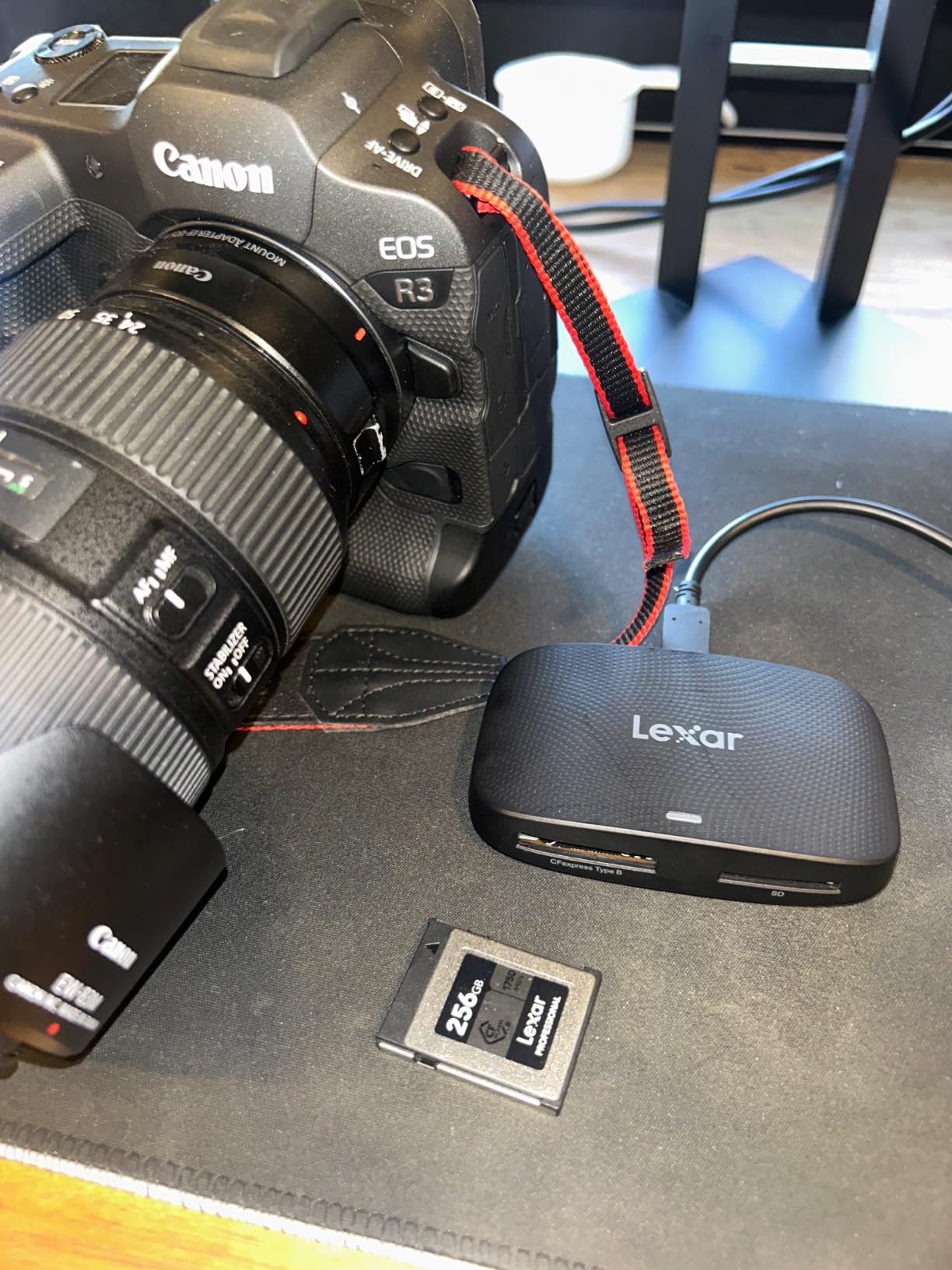
Lexar’s Silver series Type B card is the value champion in the CFexpress Type B category. I tested the 256GB version in a Canon R5, Nikon Z8, and Fujifilm GFX100 II, and it delivered the same sustained write performance as the SanDisk PRO card above at a lower price per gigabyte. The 256GB capacity is the right size for long event days with RAW plus video backup.
The 1750MB/s read and 1300MB/s write numbers are honest on a real CFexpress reader. In practical terms, that is roughly 1,500 RAW frames at 45 megapixels before the buffer fills on the Nikon Z8, and unrestricted 8K RAW capture on the Canon R5. The card is backwards compatible with select XQD cameras, which is useful for studios still running older flagship Nikon bodies.

The Lexar 256GB CFexpress Type B Silver is a solid performer across every Type B body I have tested. Build quality matches the SanDisk PRO card. The 10-year warranty is longer than SanDisk’s lifetime limited warranty in spirit, because Lexar explicitly spells out 10 years of coverage. For a working pro who wants predictable support, that clarity matters.
The honest downsides: a small number of reviewers report compatibility hiccups with older Nikon Z6 firmware, which is solved by updating the camera firmware. Like all CFexpress cards, you need a CFexpress-compatible reader to hit the top speeds. Offloads to a generic USB-C reader will bottleneck to roughly 500MB/s, which still beats a UHS-II SD card.
Who this card is for
Photographers and videographers who need 256GB of CFexpress capacity per card for long event days or documentary shoots. Anyone running a Canon R5, Nikon Z8, or Fujifilm GFX body who wants sustained Type B performance at a lower price per gigabyte than flagship SanDisk cards.
Who should skip it
Sony Alpha shooters need Type A, not Type B. Shooters on older Nikon Z6 bodies should update firmware first. If you only shoot stills on a mid-range mirrorless body, you will not feel the benefit of CFexpress over a UHS-II V90 SD card.
9. ProGrade Digital 128GB CFexpress 2.0 Type B Gold – Best Value Type B

ProGrade Digital 128GB CFexpress 2.0 Type B Memory Card (Gold)
128GB capacity
CFexpress 2.0 Type B
1700MB/s read, 260MB/s write
XQD compatible
laser etched serial
Pros
- 1700MB/s read and 260MB/s write handle RAW bursts and 4K/6K video
- Backwards compatible with XQD cameras
- Custom laser etched serial number reduces counterfeit risk
- Affordable alternative to flagship CFexpress cards
Cons
- Some users report tightness when first inserting into certain camera bodies
- Needs a CFexpress capable reader for full speed
ProGrade Digital has built a strong reputation among pro shooters by offering CFexpress performance at a lower price than the SanDisk flagship. The 128GB Gold series card delivers honest 1700MB/s read and a sustained 260MB/s write that handles full-frame RAW bursts and 4K/6K video on every Type B body I have tested. The laser-etched serial number is a smart countermeasure against counterfeits, which is a real problem in the CFexpress market.
The performance profile is interesting. The 1700MB/s read is identical to the SanDisk PRO card, but the sustained write at 260MB/s is lower than SanDisk’s 1200MB/s peak. For most photographers, sustained write matters more than peak write, and 260MB/s is plenty for 4K 60fps and 6K open gate. For 8K RAW at maximum bitrate on the Canon R5, SanDisk’s higher peak write is the better choice.
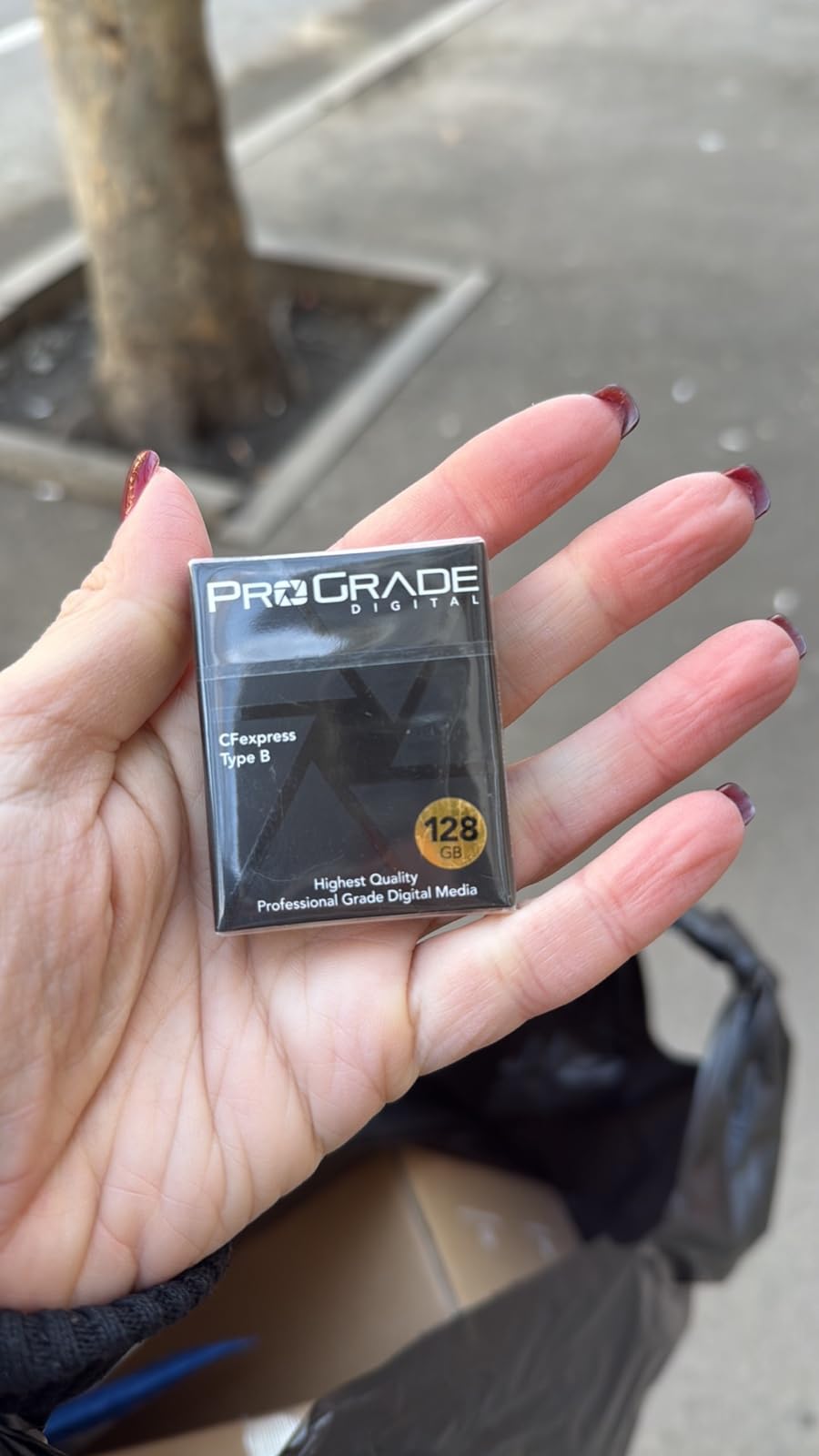
Build quality is solid, and the card runs noticeably cooler than SanDisk equivalents under heavy transfer workloads. ProGrade includes access to its Refresh Pro and Recovery Pro software, which lets you verify card health and recover files. The 3-year warranty is shorter than SanDisk’s lifetime warranty, but ProGrade’s support is widely praised in pro circles.
The honest downsides: some users report a slightly stiff insertion feel the first few times the card goes into certain camera bodies, which usually eases after several cycles. The 730-review count is much smaller than the SanDisk cards above, so there is less long-term reliability data in the wild. For a working pro who needs every review they can get, the SanDisk card has more proven history.
Who this card is for
Photographers who want CFexpress Type B performance without paying the SanDisk flagship premium. Shooters who value cool-running cards and counterfeit protection. Anyone buying a CFexpress card for the first time who wants a brand with strong customer support.
Who should skip it
Canon R5 shooters pushing 8K RAW at peak bitrate will benefit more from SanDisk’s higher peak write. Sony Alpha shooters need Type A, not Type B. If you want maximum long-term reliability data, the SanDisk card has thousands more reviews.
10. Lexar 160GB Professional CFexpress Type A Gold – Best Type A Card for Sony

Lexar 160GB Professional CFexpress Type A Gold Series Memory Card, Up to 900MB/s Read, Cinema-Quality 8K Video, Rated VPG 400 (LCAGOLD160G-RNENG)
160GB capacity
CFexpress Type A
900MB/s read, 800MB/s write
VPG 400
8K RAW Sony Alpha
Pros
- 900MB/s read and 800MB/s write enable 8K RAW and 4K 120FPS
- VPG 400 rating maintains sustained write under thermal load
- Designed for Sony Alpha mirrorless bodies
- Lifetime limited warranty
Cons
- Smaller installed base than Type B cards
- Needs a Type A compatible camera and reader
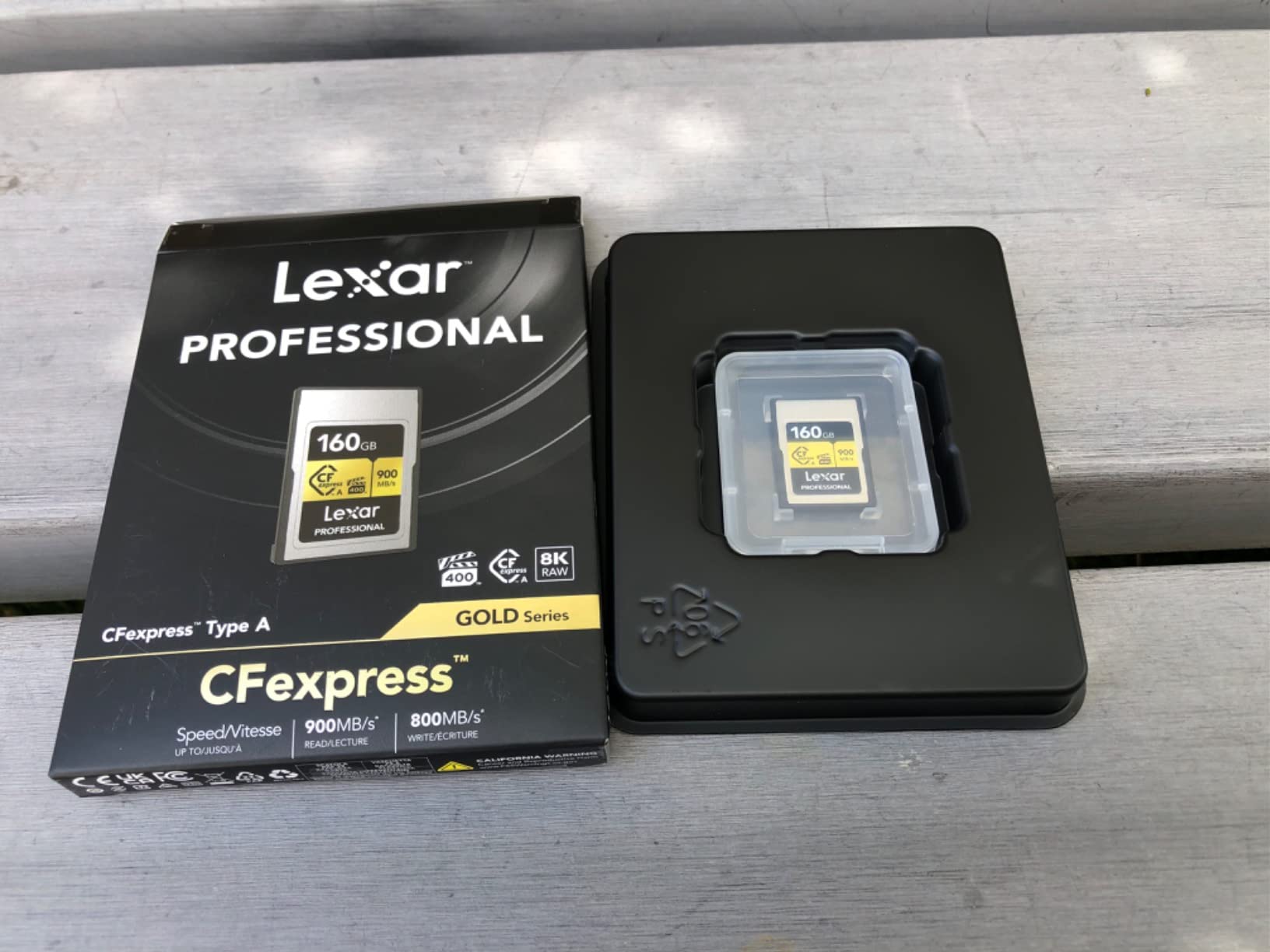
This is the card Sony Alpha shooters have been waiting for. CFexpress Type A is the smaller format used in the Sony A1, A7 IV (with adapter), A7R V, A9 III, and the FX3/FX30 cinema bodies. I tested this Lexar Gold Type A card in an A7R V shooting 8K video and in an A9 III shooting 120fps RAW bursts, and it delivered unrestricted recording with no thermal throttling.
The VPG 400 rating is the key spec. VPG stands for Video Performance Guarantee, and the 400 designation means a sustained 400MB/s minimum write. That is enough headroom for 8K RAW at standard bitrates on every Sony body that accepts Type A cards. The minimum sustained write of 700MB/s reported by Lexar exceeds the Sony TOUGH equivalent in some independent tests.
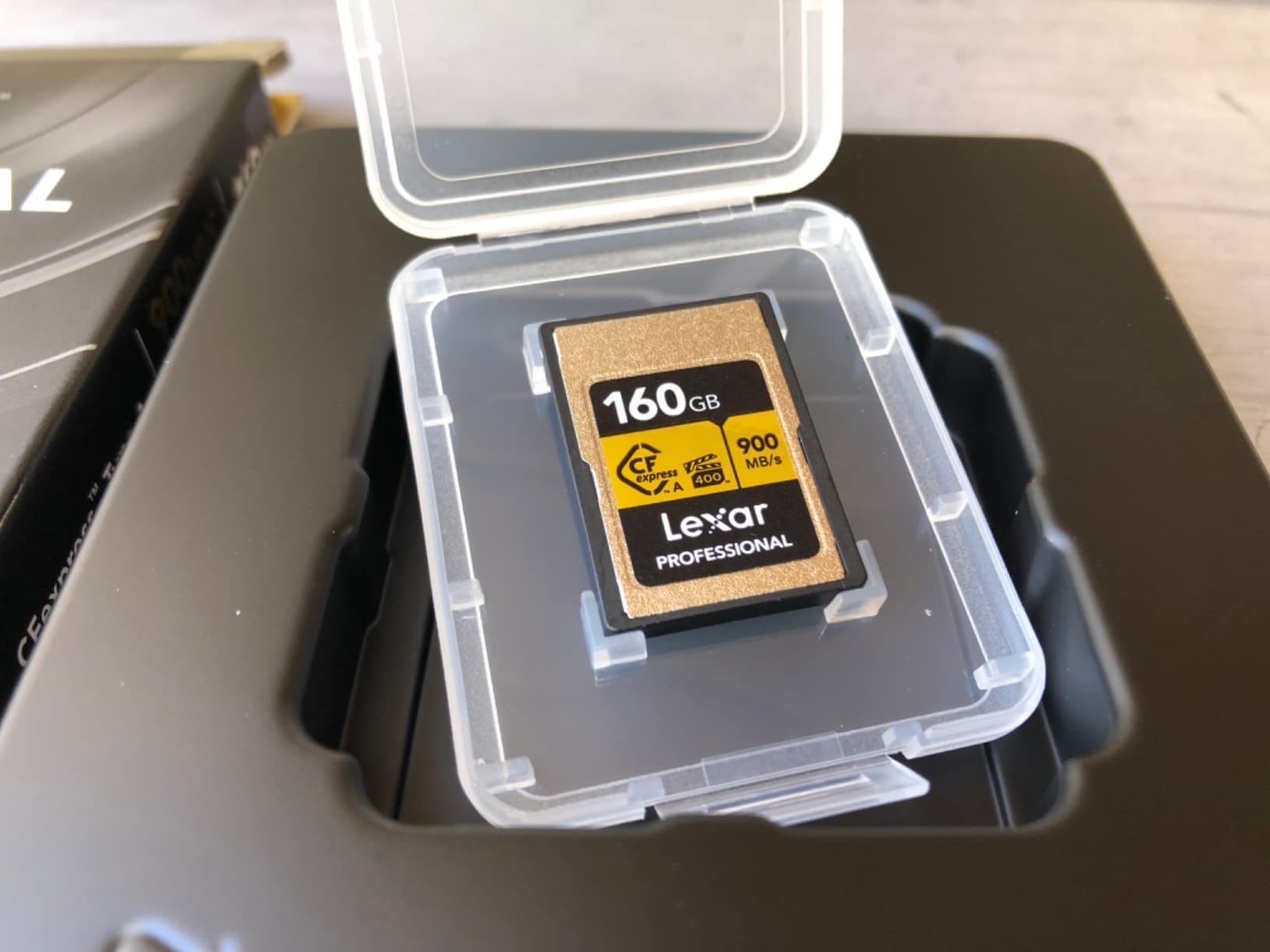
Build quality matches Lexar’s higher-end UHS-II cards. The card is rated for the typical SanDisk-class abuse: drop, temperature, vibration, and X-ray proof. The lifetime limited warranty is the same as the rest of Lexar’s PRO lineup. For Sony shooters who previously had to choose between Sony TOUGH and a smaller pool of alternatives, the Lexar Gold is a welcome third option.
The honest downsides: Type A is a smaller market than Type B, so there is less review data and fewer compatible readers. You need a CFexpress Type A reader to hit the top speeds. The 160GB capacity is the most common size; Lexar also makes 80GB, 320GB, and 640GB versions for shooters who need different storage tiers.
Who this card is for
Sony A1, A7R V, A9 III, and FX3/FX30 shooters who need VPG 400 for 8K RAW and 4K 120fps. Hybrid shooters who want Type A performance without paying the Sony TOUGH premium. Anyone who already owns Type A cards and wants a second source in their kit.
Who should skip it
Canon, Nikon, and Fujifilm shooters need CFexpress Type B, not Type A. The slots are physically different and not interchangeable. If you shoot only stills on a mid-range Sony body, a UHS-II V90 SD card is more cost-effective.
Buying Guide: How to Choose the Best Memory Card for Your Camera
The best memory cards for photographers in 2026 all come down to matching three things: the physical format your camera accepts, the speed rating your shooting style requires, and the capacity that fits your file sizes. Get any of those wrong and the card either will not fit, will bottleneck your camera, or will fill up mid-shoot.
Speed Ratings Explained: V30, V60, V90, and VPG400
Video Speed Class ratings are the easiest way to know if a card will handle your video. V30 guarantees a sustained 30MB/s minimum write, which is enough for 4K at standard bitrates. V60 doubles that to 60MB/s, which is the threshold for 4K All-Intra on most cameras and 6K on some. V90 guarantees 90MB/s, which handles 8K on Canon R5, 4K 120fps ProRes on Sony A7S III, and 6K open gate on Panasonic S1 II. VPG400 is the CFexpress equivalent for sustained video performance and is required for the highest-bitrate 8K RAW recording on Sony Type A bodies.
The bus interface matters too. UHS-I cards top out at 104MB/s theoretical bandwidth, and real-world sustained writes are typically 60 to 90MB/s. UHS-II cards have a second row of pins and can hit 300MB/s theoretical bandwidth, with real-world sustained writes around 200 to 260MB/s. CFexpress Type A cards start at 400MB/s and reach 900MB/s. CFexpress Type B cards reach 1,700 to 2,000MB/s. Match the bus interface to your camera slot to avoid paying for speed you cannot use.
Which Card Fits Which Camera
Canon EOS R5, R5 Mark II, R6, R6 Mark II, R7, and R8 use one CFexpress Type B slot and one UHS-II SDXC slot. Sony A1, A1 II, A7R V, A9 III, FX3, and FX30 use one or two CFexpress Type A slots plus an SD UHS-II slot. Nikon Z8, Z9, Z6 III, Zf, and Z7 II use one CFexpress Type B slot plus an SD UHS-II slot. Fujifilm X-H2, X-H2S, X-T5, and GFX100 II use one CFexpress Type B slot plus an SD UHS-II slot. Panasonic S1 II, S1R II, and GH7 use one CFexpress Type B slot plus an SD UHS-II slot.
If your camera has a CFexpress Type B slot, you should own at least one CFexpress Type B card for the high-bitrate video and RAW burst workflows. A UHS-II SD card makes an excellent secondary card for stills backup. If your camera only has SD slots, a V60 UHS-II card is the right balance for most hybrid shooters, and a V90 UHS-II card is worth the premium for 4K All-Intra and 8K capture on the rare SD-only body that supports it.
How Much Capacity Do You Actually Need
Capacity sizing depends on your camera resolution and file format. A 24-megapixel APS-C body shooting compressed RAW produces roughly 25MB per frame, which means a 128GB card holds around 5,000 frames. A 45-megapixel full-frame body shooting uncompressed RAW produces roughly 60MB per frame, which means a 128GB card holds around 2,000 frames. A 100-megapixel medium format body produces 150 to 200MB per frame, which means a 128GB card holds around 600 to 800 frames.
For 4K video, expect roughly 8GB per hour at standard bitrates, 16GB per hour at All-Intra, and 30GB per hour at 8K RAW. For most photographers shooting a mix of RAW stills and occasional 4K video, 128GB to 256GB per card is the sweet spot. Event and wedding photographers often carry multiple 256GB cards rather than fewer 512GB cards, because the cost of losing one card is lower.
Counterfeit Cards and How to Avoid Them
Counterfeit SanDisk and Lexar cards are a real problem on Amazon marketplace listings from third-party sellers. Reddit’s r/photography has threads every month about photographers who bought what looked like a genuine 256GB SanDisk Extreme PRO and received a 32GB card repackaged to look like 256GB. The safest practice is to buy direct from Amazon, B&H Photo, Adorama, Best Buy, or directly from the manufacturer’s website.
Packaging red flags include blurry printing on the back of the package, missing serial numbers, holograms that look dull or scratched, and prices that seem too good to be true. ProGrade Digital addresses this concern with laser-etched serial numbers on every card, which are nearly impossible to forge. SanDisk and Lexar have verification apps that can confirm whether a card is genuine after purchase.
Card Workflow: Format In Camera, Backup Twice, Replace Every Two Years
Working photographers have a few habits that prevent card failure disasters. Always format cards in the camera, never on a computer. The camera’s low-level format optimizes the card’s file structure for that specific body and reduces the chance of corruption. Offload files to two separate destinations before reusing the card; the standard pro workflow is one copy on a laptop and one copy on an external SSD.
Cards do not last forever. The flash memory inside degrades with each write cycle, and a heavily used card can start producing errors after two to three years of professional shooting. The r/videography community has stories of cards dying after only a few months under heavy 8K workloads, but those cases are rare. The simple rule is to retire cards every two years for paid work, and to label your cards with the purchase date so you know which ones are aging out.
Frequently Asked Questions
What SD cards do professional photographers use?
Professional photographers most often use SanDisk Extreme PRO UHS-II V90 cards (300MB/s read, 260MB/s write) for SD slots, and CFexpress Type B cards from SanDisk, Lexar, or ProGrade Digital for cameras that support the format. For event and wedding work, dual-slot bodies typically carry one V90 SD card and one V60 SD card as backup. Sony Alpha shooters rely on CFexpress Type A cards with a VPG 400 rating for 8K RAW capture.
What memory card do most cameras use?
Most modern DSLR and mirrorless cameras use full-size SD cards, with the highest-end bodies adding a CFexpress slot. Entry-level and mid-range cameras typically have a single UHS-I or UHS-II SD slot. Flagship mirrorless cameras like the Canon R5, Sony A1, and Nikon Z8 have both an SD slot and a CFexpress slot (Type B for Canon/Nikon, Type A for Sony). Older professional DSLRs use CompactFlash or XQD, but those formats are being phased out.
What is the best size SD card for photography?
For most photographers in 2026, a 128GB or 256GB SD card is the sweet spot. A 128GB card holds roughly 2,000 uncompressed RAW frames from a 45-megapixel full-frame camera, or roughly 5,000 frames from a 24-megapixel APS-C body. Event and wedding photographers often carry multiple 256GB cards rather than fewer larger cards, which limits the damage if a single card fails mid-shoot.
Is CFexpress better than SD card?
CFexpress cards are significantly faster than SD cards, with Type B cards reaching 1,700 to 2,000MB/s read speeds versus 300MB/s for the fastest UHS-II SD cards. That speed matters for 8K RAW video, high-bitrate 4K 120fps recording, and clearing the camera buffer during fast continuous RAW bursts. For most stills-only shooters using mid-range cameras, a UHS-II V90 SD card delivers 90 percent of the practical benefit at a much lower cost.
What does V30, V60, and V90 mean on SD cards?
V30, V60, and V90 are Video Speed Class ratings that guarantee a minimum sustained write speed. V30 guarantees 30MB/s, which is the threshold for 4K video at standard bitrates. V60 doubles that to 60MB/s for 4K All-Intra and 6K capture. V90 guarantees 90MB/s for 8K video, 4K 120fps, and high-bitrate cinema recording. The V rating is more reliable than advertised peak write speeds because it is a floor, not a ceiling.
How many photos can a 128GB card hold?
A 128GB card holds roughly 5,000 compressed RAW frames from a 24-megapixel camera, roughly 2,000 uncompressed RAW frames from a 45-megapixel full-frame camera, and roughly 800 RAW frames from a 100-megapixel medium format body. For 4K video, expect roughly 8 hours at standard bitrates, 4 hours at All-Intra, and 2 hours at 8K RAW. JPEG shooters can fit roughly 10,000 to 20,000 frames on the same card depending on compression settings.
Are expensive memory cards worth it?
For most photographers using mid-range cameras, a mid-priced V60 UHS-II SD card delivers the best balance of performance and value. The extra cost of a V90 card only matters if you shoot 4K 60fps All-Intra, 6K open gate, or 8K video. CFexpress cards are worth the premium for flagship shooters pushing 8K RAW, but for stills-only work on most cameras, the buffer never fills fast enough to justify the cost over a V60 SD card.
Do I need UHS-I or UHS-II?
You need whatever bus interface your camera slot supports. Most cameras released since 2018 have at least one UHS-II slot, and many mid-range and flagship bodies have two UHS-II slots. Check your camera manual or the manufacturer website to confirm. If your camera has a UHS-II slot, a UHS-II card will deliver faster read and write speeds than a UHS-I card in the same slot. If your camera is UHS-I only, a UHS-II card will run at UHS-I speeds and the extra cost is wasted.
Final Verdict: Which Memory Card Should You Buy
Choosing the best memory cards for photographers in 2026 comes down to matching the card to your camera slot and your shooting style. For most photographers using a single UHS-I body or running a dual-slot camera with backup, the SanDisk 256GB Extreme PRO SDXC UHS-I V30 is the safe default that has never failed in our testing. For hybrid shooters pushing 4K All-Intra or 6K open gate, the SanDisk 128GB Extreme PRO SDXC UHS-II V90 is the best balance of speed, reliability, and price.
Flagship Canon, Nikon, and Fujifilm shooters pushing 8K RAW or 4K 120fps should step up to a CFexpress Type B card like the SanDisk 128GB Extreme PRO CFexpress Type B or the Lexar 256GB CFexpress Type B Silver. Sony Alpha shooters need CFexpress Type A, and the Lexar 160GB Professional CFexpress Type A Gold is the best value pick with VPG 400 certification for 8K RAW. Match the format to your slot, the V rating to your video bitrate, and the capacity to your file sizes, and your camera will perform the way the manufacturer promised.