
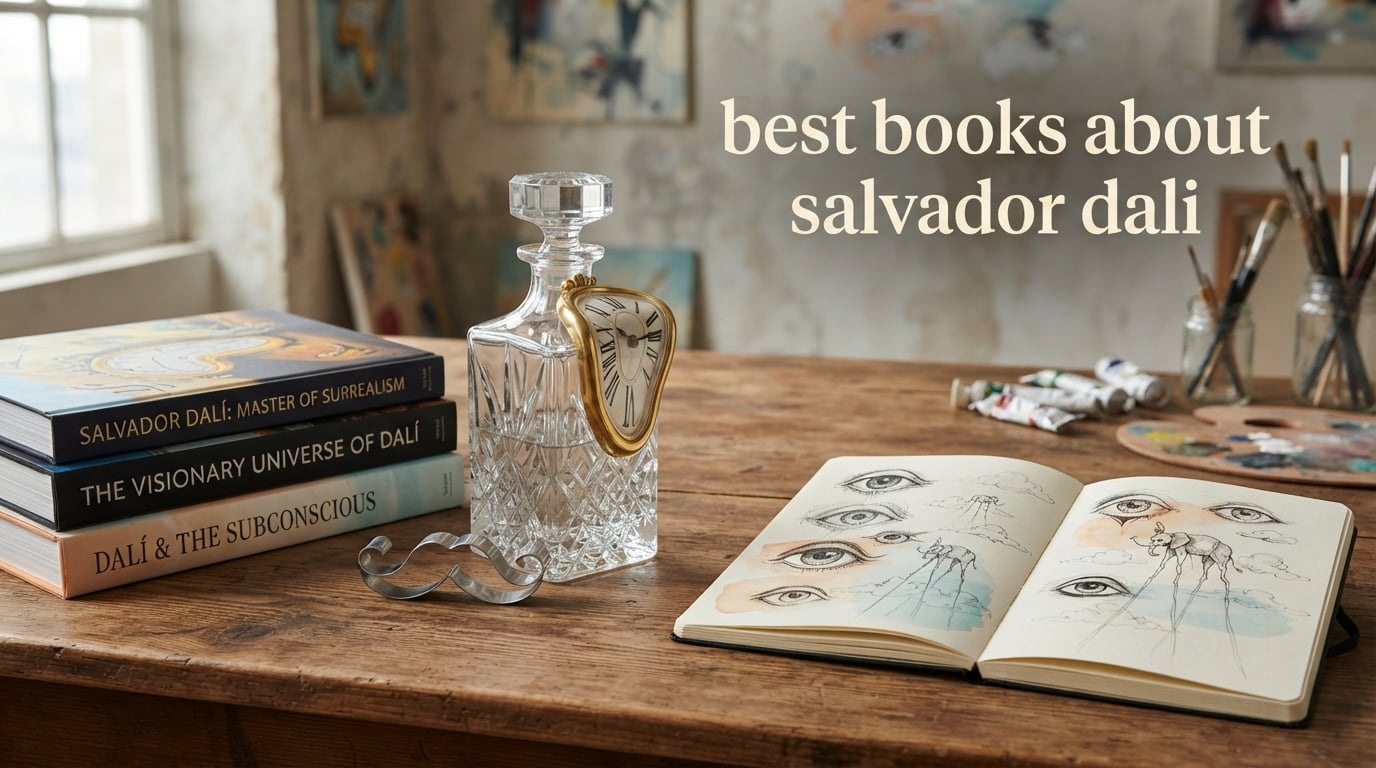
Salvador Dalí painted melting clocks, raised his pencil like a conductor’s baton, and once declared himself a genius in print. His body of work spans oil paintings, film collaborations with the Marx Brothers, and a small but unforgettable library of books he wrote himself. If you want to understand this surrealist provocateur, reading about him is part of the experience.
The short answer to the most common question: the best book about Salvador Dalí is The Secret Life of Salvador Dalí, his own 1942 autobiography, because no third-party writer gets closer to the source. For art students and visual learners, Dalí: The Paintings from Taschen’s Bibliotheca Universalis series offers the most comprehensive collection of reproductions. If you want a balanced biography from someone who actually met him, Dalí & I by Stan Lauryssens is the modern pick.
This guide covers Dalí’s autobiographies, scholarly biographies, large-format art books, children’s titles, and Surrealism companion reads. I also walk you through how to tell accurate biographies from sensationalized ones, and share a recommended reading order so you don’t waste time on the wrong book first.
Table of Contents
Quick Picks: Best Books About Salvador Dalí
Short on time? Start here. These five titles cover the autobiographies, biographies, and art books most readers end up reaching for.
- Best autobiography: The Secret Life of Salvador Dalí by Salvador Dalí (1942)
- Best third-party biography: Dalí & I: The Surreal Story by Stan Lauryssens
- Best art book: Dalí: The Paintings (Taschen Bibliotheca Universalis)
- Best for kids: Who Was Salvador Dalí? by Paula K. Manzanero (Penguin Who HQ)
- Best coffee table book: Salvador Dalí: The Impossible Collection by Paul Moorhouse (Assouline)
Keep scrolling for full context on each category, the recommended reading order, and a frank discussion of which books to skip.
Dalí’s Own Words: The Essential Autobiographies
If you want to read Dalí unfiltered, his own books are the place to start. Dalí wrote in a flamboyant, unreliable, sometimes infuriating voice, which is precisely what makes his autobiographies worth reading. They are part confession, part performance, part manifesto.
The Secret Life of Salvador Dalí
Published in 1942 in English (translated by Haakon Chevalier), The Secret Life of Salvador Dalí covers his childhood in Figueres, his expulsion from the Madrid academy, his arrival in Paris, and his partnership with Gala. The book is filled with wild anecdotes: Dalí eating his own dinner guests’ leftovers, his fixation on Hitler (which he later walked back), and his psychoanalytic dream journals.
Readers should treat this book as performance art rather than a factual memoir. Critics have noted that dates, names, and sequences frequently shift. But the prose captures the surrealist voice Dalí cultivated in person, and that alone makes it essential. It belongs on the shelf of anyone studying 20th-century art.
Diary of a Genius
Diary of a Genius, first published in 1964, is Dalí’s second major autobiographical work and covers the years 1952 to 1963. The entries are uneven in length, some only a single sentence, others several pages. He writes about his marriage to Gala, his religious turn in the 1940s and 1950s, and his reactions to modern painters like Pollock.
This book is shorter and stranger than The Secret Life, which makes it a good second read. Once you’ve absorbed the larger narrative arc, the diary form rewards patient readers with a more intimate portrait of how Dalí worked day to day.
Hidden Faces
Hidden Faces is Dalí’s only novel, written during World War II. It’s a thinly veiled roman à clef about a love triangle among aristocrats, with Surrealist set pieces and an apocalyptic ending. The book sold poorly when it appeared in 1944 and has been overshadowed by his autobiographies ever since.
That obscurity is a shame. Hidden Faces is where Dalí most clearly states his personal mythology about Gala, who appears as a character called GALA. If you read it after the two autobiographies, you’ll see how his fiction and his self-mythology feed each other.
Oui: The Paranoid-Critical Revolution
Oui, published in French in 1971 and translated to English in 1998, is the most theoretical of Dalí’s books. It collects essays and manifestos about the paranoiac-critical method, his self-coined term for unlocking hidden images in everyday objects. Art students will find more practical material here than general readers will.
The Best Biographies About Salvador Dalí
Dalí’s friend André Breton famously called him “Avida Dollars” (an anagram of Salvador Dalí), a jab at his commercial instincts. Third-party biographers have wrestled with separating the artist from the performance ever since. These are the biographies that handle that tension best.
Dalí: The Work, the Man by Robert Descharnes
Robert Descharnes was Dalí’s personal secretary and photographer for roughly three decades. His book Dalí: The Work, the Man runs about 450 pages and weighs roughly three pounds, the kind of doorstop you feel in your hands. Reddit users on r/SalvadorDali who want a comprehensive single volume consistently recommend it.
Because Descharnes had direct access, the book contains hundreds of photographs taken in Dalí’s home and studio, many not reproduced elsewhere. The downside: Descharnes was close to his subject and pulls punches during Dalí’s more controversial moments, including his post-1940 political stances. Read this for the visual record and the insider perspective, then look elsewhere for critical distance.
Dalí by Gilles Neret (Taschen Basic Art series)
Gilles Neret’s monograph in Taschen’s Basic Art series is the most accessible scholarly biography at a reasonable size. It’s about 96 pages, heavily illustrated, and covers Dalí’s major periods with reliable dating and provenance notes. Art history students often get assigned this one.
The Taschen Basic Art books follow a standardized format, so you know exactly what you’re getting: a tight biographical essay, a chronology, and roughly 100 color plates. It’s a good first art-history reference for Dalí.
Dalí & I: The Surreal Story by Stan Lauryssens
Belgian journalist Stan Lauryssens spent two decades covering Dalí and interviewed him several times before Dalí’s death in 1989. Dalí & I is the most readable modern biography for general audiences. Lauryssens takes a critical stance on Dalí’s post-war money-making schemes and his relationship with a younger lover named Amanda Lear, neither of which older biographies address in detail.
If you only read one third-party biography, this is the one I recommend. It’s roughly 300 pages, written as a narrative, and balances sympathy with the kind of healthy skepticism a friend of Dalí couldn’t always muster.
Gala: The Surrealist Muse
No honest biography of Dalí can ignore Gala, his wife, business manager, and the model for many of his paintings. Several books center her role: Gala: The Surrealist Muse and Meredith Etherington-Smith’s The Persistence of Memory: A Biography of Dalí both place her at the center of the story.
Dalí met Elena Ivanovna Diakonova in 1929 when she was still legally married to the poet Paul Éluard. She left Éluard for Dalí within a year and managed his career until her death in 1982, after which Dalí’s own output collapsed. Biographers now treat Gala as a co-author of the Dalí brand.
Stunning Art Books and Coffee Table Volumes
Dalí produced roughly 1,500 paintings across seven decades, plus prints, drawings, lithographs, sculptures, and films. No single volume contains them all, but a handful of art books come closer than the rest.
Dalí: The Paintings (Taschen Bibliotheca Universalis)
Taschen’s Dalí: The Paintings in the Bibliotheca Universalis series is the most cited single-volume art book on Dalí. At about 9 by 11 inches, it’s mid-format: bigger than a paperback but smaller than a true coffee table book. The reproductions are excellent, the text is reliable, and the price is reasonable.
If you can only buy one art book on Dalí, this is it. Reddit users comparing Taschen volumes frequently note the 9-by-11 size is comfortable for both reading and display, even if some readers want larger plates.
Salvador Dalí: The Impossible Collection (Assouline)
Assouline’s Impossible Collection series curates exactly 100 works from legendary artists, and the Dalí volume was edited by Paul Moorhouse of the Tate. The book is a large-format square, roughly 12 by 12 inches, printed on heavy stock.
This is the book to buy if you want a centerpiece on a coffee table. It’s also a status object; Assouline positions the Impossible Collection series as luxury décor. The downside is that with only 100 plates, you get a curated cross-section rather than a comprehensive catalogue.
Dalí in 400 Images
Published in connection with The Dalí Museum in St. Petersburg, Florida, Dalí in 400 Images offers a broader sampling than the Assouline book at a more accessible format. It’s a good middle option between the Taschen volume and the Assouline luxury title.
The Dalí Museum itself publishes a small line of books through its shop, including exhibition catalogs and research volumes. If you’re serious about Dalí scholarship, browse shop.thedali.org directly. They carry titles that aren’t always listed on Amazon.
The Dalí Museum Publications
The Dalí Museum in St. Petersburg, Florida, holds the largest collection of Dalí’s work outside Catalonia. Their publications include exhibition catalogs that go deeper on individual periods (the nuclear mysticism phase, the late religious works, the ballet designs) than the broader survey volumes. Look for titles by curators like William Jeffett or Montse Aguer.
Best Books About Surrealism and the Movement
Dalí didn’t work in a vacuum. If you’re new to Surrealism, you may want a movement-level overview alongside the Dalí-focused reads.
Surrealism: The Big Ideas and The Surrealists: Their Lives and Ideas
Two strong starting points exist. Surrealism: The Big Ideas from the Musée de Beaux-Arts of Lyon gives a museum-quality overview of the movement. The Surrealists: Their Lives and Ideas, often found in the kids-art-box.com reading list, focuses on the personalities. Both are accessible to non-specialists.
Lives of the Surrealists
Desmond Morris’s Lives of the Surrealists is the biographical survey most readers end up picking up. It profiles 32 surrealists across the movement’s lifespan, with Dalí getting a chapter that places him alongside Magritte, Ernst, Breton, and Carrington.
For readers who want to understand how Dalí fit into the broader movement, especially the 1930s Paris group, this is the volume to reach for.
The Dalí Museum Café Gala Cookbook
One more unexpected pick: The Dalí Museum in St. Petersburg publishes a cookbook inspired by Dalí’s relationship with food and Gala’s Russian heritage. It’s a quirky gift for the Dalí fan in your life and a reminder that the Dalí Museum publishes far more than just exhibition catalogs.
Best Books About Dalí for Kids and Young Readers
Dalí loved children and the surrealists loved wordplay, so the children’s section is unusually strong. Several titles work for elementary-school readers, a few go up through middle school, and one (Just Being Dalí) is aimed at older picture-book audiences.
Who Was Salvador Dalí? by Paula K. Manzanero
Part of Penguin’s Who HQ series, Who Was Salvador Dalí? is the standard recommendation for ages 8 to 12. The series uses a friendly question-and-answer format, black-and-white illustrations, and roughly 100 pages of biographical content.
If you’re a parent or teacher introducing Dalí to a child, this is the safest starting point. The book touches on Dalí’s most famous paintings without dwelling on controversial aspects of his adult life.
Getting to Know the World’s Greatest Artists: Dalí
Mike Venezia’s Getting to Know the World’s Greatest Artists series uses cartoon illustrations and humor to introduce major artists to elementary-school readers. The Dalí volume is one of the stronger entries. Children respond to the comic-book format, and the playful tone matches Dalí’s public persona.
Just Being Dalí: The Story of Artist Salvador Dalí
Amy Leggett and Berger’s Just Being Dalí is a newer picture book that emphasizes Dalí’s childhood imagination. It works well for ages 5 to 9 and is often recommended alongside The Nonsense Show, Dalí’s own children’s book, for the youngest readers.
Dalí and the Path of Dreams
Written by Obdulia Ortiz, illustrated by Sebastià Serra, and translated from Catalan, Dalí and the Path of Dreams is the most culturally grounded children’s book on the list. It tells a story inspired by Figueres and the Empordà region, with paintings recreated in the illustrations.
The Nonsense Show
The Nonsense Show, published in 2015, is Dalí’s own children’s book. Originally conceived decades earlier, it was finally completed with author Mo Willems and illustrator Eric Fan. The book is surreal in the truest sense: optical illusions, hidden faces, and an elephant on a moon.
George Orwell’s Essay on Dalí and Other Notable Critical Writings
If you’ve searched for Dalí books online, you’ve probably come across the question of what George Orwell wrote about him. Orwell’s 1944 essay “Benefit of Clergy: Some Notes on Salvador Dalí” is one of the most quoted critical texts on the artist.
“Benefit of Clergy” by George Orwell
Orwell, then writing for the Tribune newspaper, took Dalí to task for his supposed pro-fascist sympathies in the 1930s. The title comes from the legal phrase for clergy who could escape secular courts: Orwell’s argument was that Dalí had avoided honest accountability by retreating into eccentricity. The essay is roughly 5,000 words and widely reprinted.
For readers who want to understand the controversies around Dalí’s political stance, especially his alleged closeness to Franco’s Spain, Orwell’s essay is essential. It’s also a useful counterweight to Dalí’s own hagiographic autobiographies.
The Subversive Eye: Surrealist and Experimental Photography from The Dalí Museum
The Dalí Museum’s photography collection includes surrealist and experimental work. The Subversive Eye, drawn from the David Raymond collection, focuses on the camera’s role in surrealist practice. It’s a more scholarly pick but adds depth to how Dalí and his circle used photography.
How to Choose the Right Dalí Book for You
With more than a dozen titles competing for your attention, a few simple rules help narrow the field. Below is a comparison framework, a recommended reading order, and a frank discussion of how to avoid biographies that lean more on scandal than scholarship.
Match the Book to Your Goal
Ask yourself what you want first: Dalí’s voice, his life story, or his pictures. Then pick the matching category.
- You want Dalí’s voice: Start with The Secret Life of Salvador Dalí.
- You want the life story: Pick Dalí & I for narrative or the Descharnes volume for visual depth.
- You want the pictures: Taschen’s Dalí: The Paintings or Assouline’s Impossible Collection.
- You’re buying for a child: Penguin’s Who Was Salvador Dalí? or Mike Venezia’s Getting to Know series.
- You’re studying Surrealism: Pair any Dalí book with Desmond Morris’s Lives of the Surrealists.
Compare Book Formats Before You Buy
The same Dalí title can exist as a 9-by-11 paperback, a 12-by-12 coffee table hardcover, or a Kindle edition. Format affects both the price and the experience.
- Pocket paperbacks (Basic Art series): 96 pages, roughly 8 by 8 inches. Best for students and travel. Affordable.
- Mid-format hardcovers (Taschen Bibliotheca Universalis): 9 by 11 inches, 500+ pages, color plates throughout. Best for reference and reading.
- Coffee table books (Assouline Impossible Collection): 12 by 12 inches, heavy stock, 100 plates curated by an expert. Best for display and gifts.
- Ebook editions: Convenient and searchable, but art reproductions lose detail on backlit screens. Avoid for art-heavy titles.
Identify Accurate Biographies Versus Sensationalized Ones
Dalí’s life included multiple controversies: his flirtation with Hitler and Mussolini in the 1930s, his relationships with much younger men, his alleged use of Gala’s estate for tax planning, and his later years of involuntary tremor possibly linked to Parkinson’s or long-term amphetamine use. Some biographies treat these as central, others skate past them.
A few rules of thumb for evaluating a Dalí biography before you commit:
- Look for access: Authors who knew Dalí personally (Descharnes, Lauryssens, Etherington-Smith) have on-the-record details, but they may pull punches.
- Look for archival work: Books grounded in letters, contemporary press coverage, and interviews are more reliable than books built on anecdotes.
- Check the date: Anything published after 2000 benefits from interviews and archives that earlier biographers didn’t have. Anything published after 2010 usually incorporates Dalí’s medical records released posthumously.
A Recommended Reading Order for Newcomers
If this is your first time reading about Dalí, here’s the order I’d suggest.
- Start with movement context: Desmond Morris’s Lives of the Surrealists, one chapter at a time. It places Dalí alongside his peers.
- Then the autobiography: The Secret Life of Salvador Dalí, knowing that it’s partly performance.
- Then the modern biography: Dalí & I by Stan Lauryssens for a more critical view.
- Then the pictures: Taschen’s Dalí: The Paintings for visual depth.
- Then the Orwell essay: “Benefit of Clergy” for counterweight.
- Finally the late diaries: Diary of a Genius to round out the picture.
That sequence gives you Dalí’s voice, his critics, his context, and his pictures in roughly six books. From there, you can follow whichever thread pulls hardest, Gala’s role, the Surrealist movement, the religious phase, or the late years.
Why a Surrealist Masterpiece Matters in These Books
Most Dalí books reproduce The Persistence of Memory (1931), his painting of melting clocks in a dreamlike landscape, which is widely considered his masterpiece. The painting hangs at the Museum of Modern Art in New York, and good art books use it as the anchor for explaining his paranoiac-critical method. When you’re browsing a candidate book, flip to the section on The Persistence of Memory first; that chapter usually signals whether the author actually understands Dalí or is recycling press-release prose.
Frequently Asked Questions
What is the best book about Salvador Dalí?
The Secret Life of Salvador Dalí, his 1942 autobiography, is the most essential single book because no one gets closer to Dalí’s voice. For art-focused readers, Taschen’s Dalí: The Paintings is the strongest art book. For a modern biography, Stan Lauryssens’s Dalí and I is the most balanced.
What did George Orwell say about Salvador Dalí?
In his 1944 essay ‘Benefit of Clergy: Some Notes on Salvador Dalí,’ Orwell accused Dalí of flirting with fascism and retreating into eccentricity to avoid accountability. He argued that Dalí’s surrealist performance protected him from honest criticism. The essay is widely reprinted and remains a touchstone for understanding the controversies around Dalí.
What was Salvador Dalí diagnosed with?
Dalí developed a severe tremor in his later years and was later diagnosed with Parkinson’s disease. Some researchers have also proposed that long-term amphetamine use contributed to his decline. He died of heart failure in 1989 at age 84.
What is Salvador Dalí’s greatest work?
The Persistence of Memory (1931), a small oil painting of melting clocks draped over a barren landscape, is widely considered Dalí’s masterpiece. It hangs at the Museum of Modern Art in New York and is reproduced in nearly every Dalí art book.
Did Salvador Dalí write a book?
Yes. Dalí wrote several books including The Secret Life of Salvador Dalí (1942), Diary of a Genius (1964), the novel Hidden Faces (1944), Oui: The Paranoid-Critical Revolution (1971), and the children’s picture book The Nonsense Show (published posthumously in 2015).
Are there good children’s books about Salvador Dalí?
Yes. Penguin’s Who Was Salvador Dalí? by Paula K. Manzanero is the standard pick for ages 8 to 12. Mike Venezia’s Getting to Know the World’s Greatest Artists: Dalí uses cartoons for elementary readers. Just Being Dalí works for younger picture-book audiences. Dalí’s own The Nonsense Show is also a strong choice.
What is the best art book of Salvador Dalí’s paintings?
Taschen’s Dalí: The Paintings in the Bibliotheca Universalis series is the most comprehensive mid-format art book, with reliable reproductions and a strong introductory essay. For a luxury coffee table option, Assouline’s Salvador Dalí: The Impossible Collection, edited by Paul Moorhouse, curates 100 essential works at a 12 by 12 inch format.
Final Thoughts on the Best Books About Salvador Dalí
If you take only one thing from this guide, take this: start with Dalí himself. The Secret Life of Salvador Dalí is the single best book about the artist because no third-party biographer can match his voice, his strangeness, or his willingness to be disliked. After that, balance his self-portrait with a modern biography like Dalí & I and an art book like Taschen’s Dalí: The Paintings, and you’ll have a richer picture of surrealism’s most famous provocateur than most casual readers ever assemble.
From there, follow whichever thread pulls hardest. Want more visual depth? Add Assouline’s Impossible Collection. Want historical context? Pair with Orwell’s “Benefit of Clergy.” Want to share Dalí with a child? Who Was Salvador Dalí? or The Nonsense Show. Whichever path you choose, 2026 is a great year to finally pick up the painter’s books and see what all the fuss is about.