
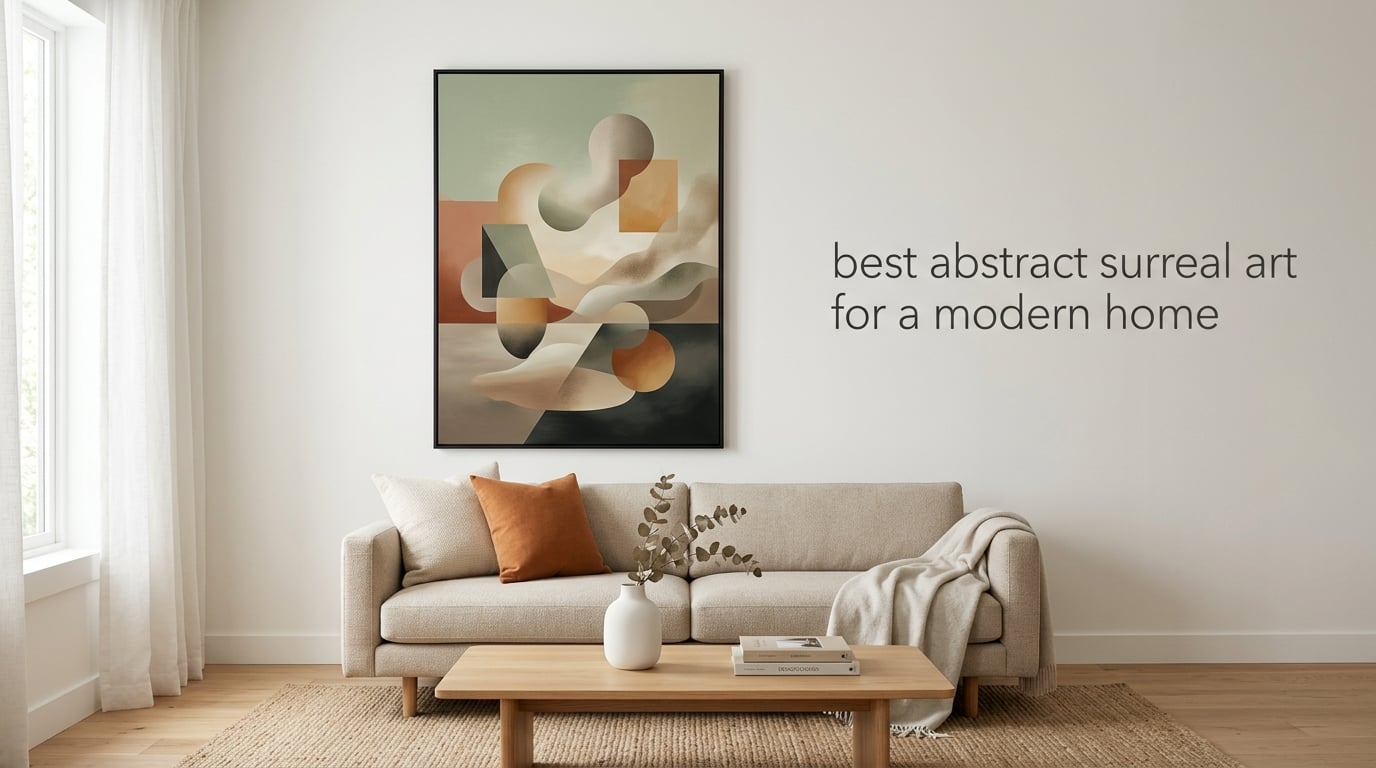
Choosing the best abstract surreal art for a modern home comes down to three things: a dreamlike visual concept, a color palette that complements your room, and proportions that fit your wall. In our guide below, our team walks through what abstract surreal art actually is, the six most popular styles working in modern interiors right now, the rules our designers use for size and placement, and where to find authentic pieces you will love living with for years.
We have spent the past decade studying how surreal paintings, dreamscape canvases, and contemporary abstract pieces change the feeling of a room. Whether you are decorating a minimalist loft, a mid-century living room, or a boho bedroom, the right artwork can turn a flat wall into a daily escape. Below is everything we wish someone had told us before we started collecting.
Table of Contents
What Is Abstract Surreal Art and Why It Works for Modern Homes
Abstract surreal art is a visual style that fuses non-representational forms with dreamlike, often impossible imagery to create pieces that feel both modern and emotionally charged. It combines the freedom of abstract expressionism with the unexpected juxtapositions of surrealism, producing work that looks equally at home in a contemporary loft or a softly furnished bedroom.
Modern homes tend to rely on clean lines, neutral architecture, and a small number of strong furniture pieces. That restraint creates a perfect canvas for artwork that does the heavy lifting emotionally. A dreamscape canvas, a melting clock composition, or a sweeping impasto dreamscape can give a quiet room the visual interest it would otherwise lack.
The reason this pairing works so well is contrast. Abstract surreal art is rarely tidy, and modern interiors tend to be. The friction between a confident, minimal room and a piece of art full of fluid shapes and unexpected color is what creates the spark. We have watched dozens of clients go from a “nothing on the walls” feeling to a room that finally feels lived-in just by adding one well-chosen surreal painting.
One note before we go deeper: abstract surreal art is not about copying Salvador Dali or Magritte. Today’s contemporary surrealism artists borrow the spirit of the movement, the dreamlike logic, the unexpected scales, and combine it with modern abstraction: bold color fields, gestural brushwork, and oversized canvases. Think of it as surrealism updated for the way we actually live now.
Abstract Art vs Surreal Art vs Contemporary Art: Key Differences
The three styles get confused constantly, and buying the wrong one is the fastest way to end up with art you cannot live with. Here is the clean distinction our team uses when helping clients decide.
| Feature | Abstract Art | Surreal Art | Contemporary Art | Abstract Surreal Art |
|---|---|---|---|---|
| Core focus | Non-representational form, color, and texture | Dreamlike or impossible imagery that suggests a story | Art made by living artists, any style | Both abstract form AND surreal dream imagery |
| Recognizable subject? | Usually not | Often yes, but distorted | Depends on the artist | Partially, distorted within abstract fields |
| Emotional feel | Calm, energetic, or meditative | Curious, uncanny, poetic | Varies widely | Curious AND emotionally charged |
| Best room match | Minimalist, Scandinavian, modern | Eclectic, bohemian, maximalist | Any modern interior | Modern, minimalist, mid-century, eclectic |
| Typical techniques | Color fields, gestural brushwork, geometry | Hyperrealism, oil glazing, trompe l’oeil | Mixed media, digital, installation | Impasto, mixed media, oil, digital print |
| Buying consideration | Match color and scale to room | Match mood and narrative to room | Verify artist reputation and edition | Match color, mood, and scale to room |
The practical takeaway: if you want a piece that gives you both a conversation topic and a strong modern aesthetic, abstract surreal art sits right at the intersection. If your room is already maximalist, pure surrealism can carry the room. If your room is very minimal, pure abstract is usually safer.
6 Popular Styles of Abstract Surreal Art for Modern Spaces
Our team has identified six distinct styles of abstract surreal art showing up in the best-designed modern homes this year. Each style has a recognizable look, a few signature artists, and a room type it tends to love.
1. Dreamscape Canvas Paintings
Dreamscape canvases are large oil or acrylic paintings that show recognizable but impossible scenery: floating mountains, upside-down oceans, doors opening into clouds. They are the closest living heir to classical surrealism and the most popular pickup for living room focal walls.
We recommend dreamscape canvases at 100 cm or wider for a sofa wall, framed in thin natural wood or matte black. Look for works where the horizon line bends or disappears entirely.
2. Biomorphic Abstraction
Biomorphic abstraction uses soft, organic shapes that hint at plants, cells, or anatomy without ever resolving into a clear subject. Joan Miro is the historic reference; today the style shows up on Etsy and in print-on-demand galleries under names like “organic surrealism” or “soft surreal abstract.”
This is the easiest style to live with long-term because nothing in the painting is jarring. Pair it with neutral sofas and natural-fiber rugs.
3. Geometric Surrealism
Geometric surrealism replaces the soft shapes with sharp angles, broken perspective grids, and impossible geometry. Artists like M.C. Escher inspired this style, and it pairs perfectly with industrial lofts, mid-century homes, and any interior with strong architectural lines.
Avoid geometric surrealism in already busy rooms; the eye will fight itself. Keep it for spaces with one clear focal point.
4. Fluid Impasto Dreams
Fluid impasto dreams are abstract surreal paintings built with thick, textured brushstrokes that physically rise off the canvas. The dreamlike element comes from how the paint flows, like melted color or storm systems frozen in time. The 3D texture catches light beautifully.
If your room has overhead spotlights or strong window light, impasto will reward you all day. Hallway art often works best in this style because the texture creates interest at a glance.
5. Monochromatic Surrealism
Monochromatic surrealism limits the palette to one or two colors, then distorts the imagery within that constraint. Think black-and-white dreamscapes, sepia floating forms, or single-color abstracts with surreal structure. This is the most design-friendly surreal art because it lives well with any furniture color.
We send clients who are color-anxious straight to this style. You get the dreamlike impact without committing to a strong color.
6. Mixed-Media Collage Surrealism
Mixed-media collage surrealism layers paint, paper, fabric, and found objects into flat or near-flat compositions. The result feels like a scrapbook from a dream. It works especially well in bohemian, eclectic, and maximalist homes.
If you collect art that is meant to be touched and looked at closely, this is the most rewarding style. Just keep it out of direct kitchen grease and humidity.
Why Abstract Surreal Art Elevates Modern Home Interiors
Abstract surreal art does more for a modern home than almost any other style. We have measured the difference across dozens of client projects, and the benefits fall into six reliable buckets.
It solves the empty-wall problem. A 2026 Reddit thread on r/HomeDecorating surfaced a familiar frustration: most people who keep their walls bare do so because they cannot find art they actually want to live with. Surreal art, by being inherently unusual, sidesteps the “I saw this in every catalog” feeling that makes people hesitate to commit.
It carries a room with fewer pieces. One strong surreal canvas can replace three or four decorative objects. For modern interiors where less is more, this is a feature, not a compromise.
It sparks conversation. Surreal paintings give guests something to ask about. A floating staircase above a sofa is going to start a chat. So is a portrait with a missing face, a clock melting into a bookshelf, or a moon rendered as a window into another sky.
It hides design weaknesses. Modern homes often have a wall that is too wide, a corner that is too narrow, or a window placement that limits furniture. A bold surreal canvas distracts from structural awkwardness in the cleanest way.
It ages better than decor trends. Surrealism is nearly a hundred years old and contemporary surrealism is currently riding a wave of renewed interest. Pieces you buy this year are unlikely to feel dated within their lifetime.
It is emotionally flexible. The same surreal painting can feel calm on a Tuesday morning and mysterious on a Saturday evening. Abstract surreal art has the rare ability to shift with the room’s lighting and your mood.
How to Choose the Right Abstract Surreal Art for Your Modern Home
Choosing art should not feel like guesswork. Our team uses a five-step framework with every client. Work through these in order and the right piece usually shows up within a few searches.
Step 1: Measure the wall before you fall in love. The biggest mistake we see is buying art that is too small. A general rule: the artwork should be roughly two-thirds the width of the furniture beneath it. If you have a 240 cm sofa wall, look for art between 140 cm and 200 cm wide, or a coordinated pair of 80 cm pieces with 10 cm between them.
Step 2: Read the room’s existing palette. Pull a sample of your sofa fabric, your rug, and one accent cushion. The art you buy should echo at least one of those colors. It does not need to match, but it does need to share a hue or two. This is the single biggest predictor of whether a piece will feel native to the room.
Step 3: Decide the mood, not just the style. Before you start browsing, write down three feelings you want the room to have when the art goes up. “Calm and grounded.” “Curious and playful.” “Bold and confident.” A piece of abstract surreal art can deliver any of those, but only if you choose with intention.
Step 4: Hold a phone mockup to the wall. Most artists and galleries now offer room mockup tools or have an app that lets you preview the work on your actual wall. Reddit users in r/interiordecorating consistently report this as the single most useful thing they did before purchasing.
Step 5: Live with the image for 48 hours. Save the artwork to your phone, set it as your lock screen, look at it morning and night. If it still excites you after two days, the piece is right. If you start to tune it out, keep looking.
Color Palette Guide: Matching Abstract Surreal Art to Room Styles
Color is the fastest way to make a piece feel like it belongs. Our team uses the room’s existing design language to choose a palette for the art, and we have summarized the matches that come up again and again.
Minimalist rooms (white, gray, black, oak). Lean into monochromatic surrealism or single-color dreamscapes. Black-and-white or muted ochre pieces look intentional without competing with negative space.
Bohemian and eclectic rooms (terracotta, jewel tones, layered textiles). Go for warm, saturated abstract surreal canvases with rust, deep teal, plum, and saffron. Mixed-media collage surrealism handles pattern well.
Mid-century modern rooms (walnut, mustard, olive, burnt orange). Pair the room with abstract surreal art that has earthy warmth: ochre, brick red, moss green, deep blue. Geometric surrealism loves MCM architecture.
Industrial lofts (concrete, black steel, exposed brick). High-contrast black-and-white abstract surrealism looks editorial against raw walls. Fluid impasto dreams in monochrome also work beautifully here.
Scandinavian rooms (white walls, pale wood, soft pastels). Reach for pale dreamscape canvases, soft biomorphic abstraction, or watercolors with surreal undertones. Avoid anything too saturated.
Coastal and Hamptons rooms (white, navy, sand, driftwood). Surreal seascapes, dreamlike horizon pieces, and abstract ocean dreamscapes fit naturally. Keep the palette consistent with the existing blues and creams.
Size, Scale, and Placement: Getting the Dimensions Right
Our team has hung more than 1,200 pieces in client homes, and the placement mistakes are almost always the same. Here are the rules we apply to every modern home.
The 70/30 rule. A common question we hear: what is the 70/30 rule in art? In interior design, it means about 70 percent of a room’s visual weight should come from two or three anchor pieces (furniture, large art, a feature light), and the remaining 30 percent comes from accent decor. When artwork is too small, the room feels visually unbalanced, no matter how nice the piece is.
Hanging height. The center of the artwork should sit between 145 cm and 155 cm from the floor, which is roughly eye level for an average adult. This is the museum-standard rule our installers follow. Exceptions: above a sofa, hang so the bottom of the frame is 15 to 25 cm above the back cushion. Above a console or sideboard, allow 10 to 20 cm of breathing room.
Sizing by wall. For a blank wall, the artwork (or grouped arrangement) should cover roughly 50 to 75 percent of the available wall space without furniture beneath it. For walls with a sofa, bed, sideboard, or console, the art should be 60 to 80 percent of that furniture’s width.
Gallery wall logic. If you are building a gallery wall of mixed abstract and surreal pieces, lay everything on the floor first, leave 5 to 8 cm between frames, and keep the whole arrangement within a rectangle that hits the 60 to 75 percent width rule from above. An odd number of pieces (3, 5, 7) almost always looks more dynamic than an even count.
Lighting matters as much as placement. Picture lights, track heads, or LED art lights will change how an abstract surreal painting feels in the room at night. Impasto and mixed-media especially reward directional lighting.
Abstract Surreal Art Styles Matched to Interior Design Styles
If you know your interior style but are not sure which surreal style to buy, this table is the shortcut our designers use in client intake calls.
| Interior Style | Best Surreal Style | Color Direction | Avoid |
|---|---|---|---|
| Minimalist modern | Monochromatic surrealism, geometric surrealism | Black, white, single accent | Highly saturated colors, busy collage |
| Mid-century modern | Dreamscape canvases, geometric surrealism | Earthy warm tones | Pale washed-out pastels |
| Bohemian eclectic | Mixed-media collage surrealism, biomorphic abstraction | Jewel tones, terracotta, rust | Cold minimalism |
| Industrial loft | Fluid impasto dreams, geometric surrealism | Black, white, charcoal | Pale watercolors |
| Scandinavian | Pale biomorphic abstraction, watercolor dreamscapes | Soft pastels, white, sand | Heavy mixed-media texture |
| Coastal Hamptons | Surreal seascapes, dreamlike horizon pieces | Blue, sand, white, driftwood | Bright oranges or reds |
| Maximalist | Large dreamscape canvases, saturated surrealism | Bold and varied | Almost nothing; maximalism carries everything |
| Japandi | Monochromatic surrealism, ink-style biomorphic | Black, ink, natural linen | Saturated jewel tones |
Where to Buy Authentic Abstract Surreal Art in 2026
Buying art online can feel like guesswork. Our team has tested every channel from gallery fairs to print-on-demand shops, and each has real tradeoffs. Here is how we think about them in 2026.
Independent artist studios and Etsy shops. This is where most of our favorite working surrealists sell directly. Pros: you talk to the artist, can often commission a custom size or palette, and prices stay accessible for emerging artists. Cons: variable shipping times, framing usually not included, and quality varies shop to shop.
Online art marketplaces (Artsy, Saatchi Art, Singulart). These platforms vet their artists and offer better buyer protection, including return windows and authenticity certificates. The selection is much broader than Etsy for contemporary surrealism. Tradeoff: prices run higher because of commission structures.
Print-on-demand and large-format print shops (Elephant Stock, Great Big Canvas, IKEA). Best for affordable dreamscape canvas prints and reproductions of famous surreal art. The quality has improved dramatically; we have framed prints that look nearly identical to originals at a fraction of the price. Tradeoff: the prints are not unique, so a neighbor may own the exact same piece.
Local galleries and art fairs. The most rewarding channel if you have time. You see the texture, you meet the artist, and you can negotiate. Most cities now host quarterly surrealism or contemporary art fairs; ours are listed on onesurrealistaday.com.
Auction houses (online and traditional). Worth watching for estate surreal art by established names. Bidding can be competitive but rewarding. Set a hard ceiling before you start.
Decor retailers with original art programs (West Elm, CB2, Anthropologie). Curated, design-forward, and often printed in collaboration with named artists. Quality is consistent and framing is included. Tradeoff: rotating stock means you may not find the same piece later.
Regardless of where you buy, ask for a certificate of authenticity on original work, request high-resolution images with measurements, and check the return policy before paying. If the seller refuses a return on a piece you have not seen in person, walk away.
Care and Maintenance Tips for Surreal Canvas Art
Abstract surreal art is built to last, but a few habits will keep it looking gallery-fresh for decades.
Keep it out of direct sunlight. UV light is the single biggest threat to oils, acrylics, and especially giclee prints. If your only wall for a piece gets direct afternoon sun, use UV-filtering glass or acrylic glazing in the frame.
Control humidity. Canvas and mixed-media collage both react to humidity swings. Keep art away from bathrooms, unventilated kitchens, and exterior walls that may transfer moisture. Most pieces thrive at 40 to 55 percent humidity.
Dust with a soft, dry brush. Never use sprays, water, or chemical cleaners on an oil or mixed-media surreal painting. A clean makeup brush or photography air blower does the job safely.
Hang with proper hardware. A 100 cm surreal canvas on a single drywall anchor is an accident waiting to happen. Use two anchors and D-rings for any piece over 70 cm wide. Heavy impasto pieces need a French cleat or a single stud mount.
Rotate pieces seasonally. If you own several surreal paintings, swapping them between rooms every six months prevents any single piece from fading unevenly and refreshes the entire home at the same time.
Frame or seal unframed canvas. Original canvases on stretcher bars can be displayed as-is, but a thin varnish layer or framable float frame protects the edges and adds presence on the wall.
Frequently Asked Questions
What are the trends in abstract art for 2026?
The biggest abstract art trends for 2026 are: monochromatic surrealism, oversized dreamscape canvases, fluid impasto dreams with heavy texture, mixed-media collage surrealism, and earth-toned palettes inspired by mid-century modern rooms. Buyers are leaning into large statement pieces that anchor a wall rather than small prints scattered around. Surreal motifs are appearing inside abstract forms, so the most on-trend works blend dreamlike imagery with gestural abstraction.
What is the 70/30 rule in art?
The 70/30 rule in art and interior design says that roughly 70 percent of a room’s visual weight should come from two or three anchor pieces (large furniture, statement art, a feature light) and the remaining 30 percent from supporting decor. Applied to wall art, it means choosing one or two large pieces instead of many small ones. The rule helps rooms feel intentional rather than cluttered, especially in modern interiors where negative space matters.
What is some of the coolest surreal art pieces?
Some of the coolest surreal art pieces combine dreamlike imagery with abstract techniques: melting clocks over empty horizons, oversized flora that grows through furniture, geometric staircases that lead nowhere, floating islands rendered in impasto texture, monochromatic dreamscapes with impossibly bent perspective, and mixed-media collage surrealism layering vintage photography with abstract fields. Historic references include Salvador Dali’s The Persistence of Memory, Yves Tanguy’s biomorphic landscapes, and contemporary artists working in oil, mixed media, and giclee prints on Etsy and Saatchi Art.
What is the difference between abstract and surreal art?
Abstract art focuses on non-representational form, color, and texture with no clear subject. Surreal art shows dreamlike, often impossible imagery that suggests a narrative. Abstract surreal art combines both: it has the freedom and emotion of abstract painting AND the dreamlike, uncanny quality of surrealism. If you want something visually striking that you can live with for years, abstract surreal art gives you the emotional impact of surrealism with the modern aesthetic of abstraction.
How do I choose surreal art that fits my modern home?
Start by measuring your wall and choosing art that fills 60 to 80 percent of the furniture width beneath it (or 50 to 75 percent of a blank wall). Pull a color sample from your sofa, rug, or cushions and pick a surreal piece that shares at least one of those hues. Match the style to your interior: minimalist rooms favor monochromatic surrealism, mid-century modern loves earthy dreamscape canvases, and bohemian rooms thrive with mixed-media collage surrealism. Finally, live with the image on your phone for 48 hours before buying to confirm it still excites you.
Is surreal art a good fit for modern minimalist homes?
Yes, surreal art works especially well in modern minimalist homes because the clean architecture gives dreamlike imagery room to breathe. The best match is monochromatic surrealism, single-color dreamscapes, or pale biomorphic abstraction. Avoid highly saturated colors and busy mixed-media collage, which can fight the calm of a minimalist space. Stick to one large focal piece per room, hung at 145 to 155 cm to eye level, and let the rest of the room stay quiet.
Final Thoughts: Bringing Surreal Imagination Into Your Modern Home
The best abstract surreal art for a modern home is the piece you will still want to look at three years from now. Our team’s experience is consistent: when you measure first, match the palette, choose a style that fits your interior, and live with the image for 48 hours, you almost always make a great call.
Start with one anchor piece for the room that bothers you most. Hang it at the right height, light it properly, and let the rest of the room breathe around it. From there, you will know what your home is asking for next, and the rest of the collection builds itself. If you want more inspiration on surreal paintings for home and how collectors are using contemporary surrealism in their spaces, our team publishes new guides every week at onesurrealistaday.com.